
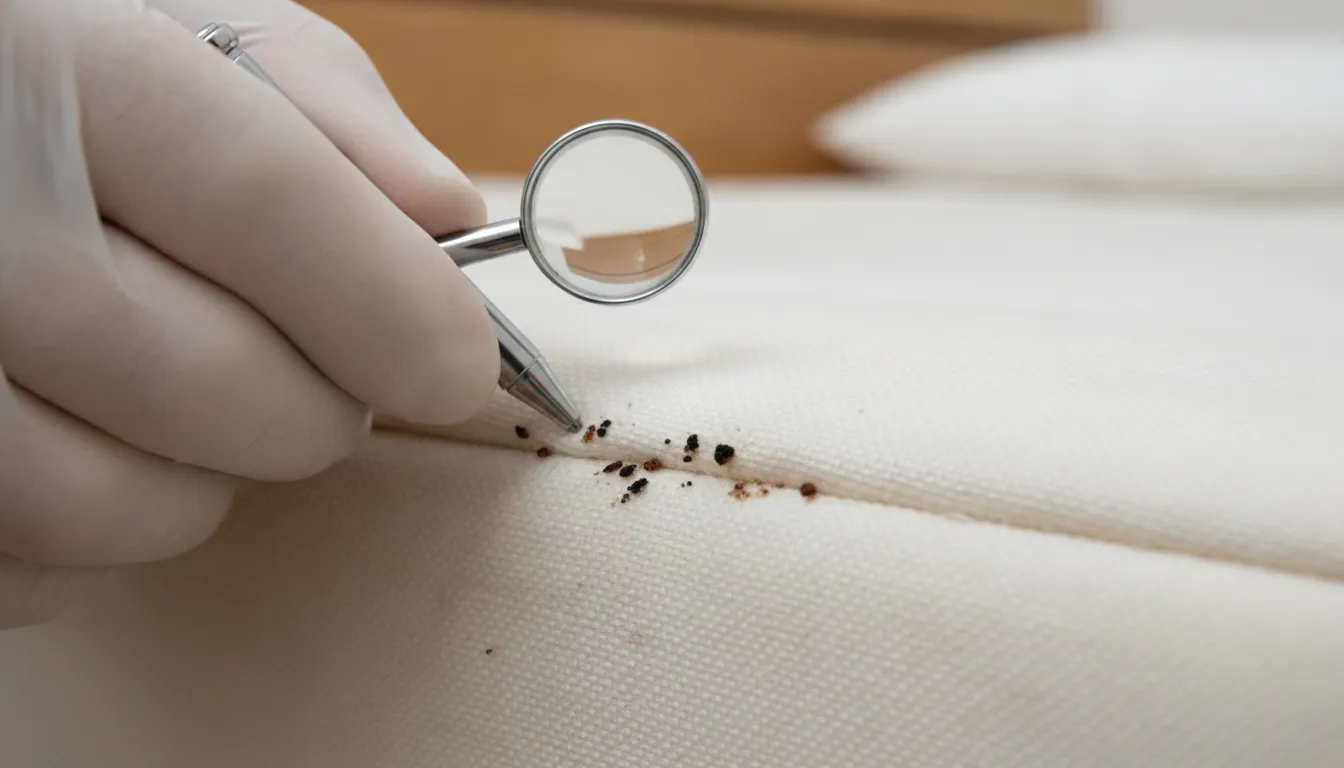
Bed bug excrement images typically show tiny, ink-black or rusty-brown dots roughly 1 mm wide that smear when wiped with a damp cloth. They cluster within a few centimeters of feeding sites, mattress seams, box spring joints, and headboard crevices. Confirming the smear separates bed bug feces from roach droppings, dirt, or mold. Dark spots alone are not proof of bed bugs, though. This guide walks you through a systematic visual and tactile process to confirm what you are seeing before you decide on next steps.
What Does Bed Bug Excrement Look Like?
Bed bug feces look like small dots made by a fine-tipped marker. Each spot is roughly 1 mm wide, round to slightly irregular, and ranges from ink-black to rusty brown depending on how long it has been there and what surface it landed on. Fresh spots on fabric tend to bleed into the fibers, producing a soft, blurred edge rather than a sharp circle. On hard surfaces like wood or plastic, the edges hold tighter and the dot looks more defined.
The texture matters as much as the color. When you press a damp cloth or moistened fingertip against a genuine bed bug dropping, it smears into a brownish streak. That smear is the single most reliable at-home confirmation you have. Dirt, mold, and roach droppings behave differently under the same test.
What most consumer guides skip is that a large share of fecal spots are not dark at all. According to a 2022 study published in the Journal of Economic Entomology, clear fecal spots make up 38.5 to 55.5% of all spots bed bugs produce, meaning well over a third of the evidence is invisible under normal light. The same research found that 5th instar bed bugs produce an average of 44.7 spots after a single meal when examined under ultraviolet light. Those clear spots are invisible to the naked eye under normal lighting, so a UV flashlight is a practical addition to any inspection kit.
On fabric, droppings often feel slightly raised before they are fully absorbed. On painted drywall, they can look like flecks of black pepper that do not wipe away cleanly with a dry cloth but do smear with moisture. The combination of size, smear behavior, and UV visibility is what separates bed bug feces from most other substances you will find on a mattress or bed frame.
Where Are Bed Bug Droppings Found? (And Why Location Matters)
Bed bugs defecate close to where they feed. Ohio State University research found that adult bed bugs typically move a mean distance of 1.0 to 2.5 cm from their feeding site before their first defecation. That short range explains why droppings concentrate in tight, sheltered zones near where a person sleeps rather than scattered randomly across a room.
The most reliable inspection zones are mattress seams and tags, box spring joints and stapled fabric folds, the gap between the headboard and the wall, and the screw holes or joints of bed frames. Baseboards directly behind the bed and the underside of nightstands are also common sites. A full list of bed bug hiding spots can help you focus a short inspection rather than checking every surface in the room.
There is some disagreement in the literature about how often droppings appear on bed sheets versus in hiding spots. Some sources treat sheets as a primary inspection site, while others consider sheet droppings relatively uncommon. The Ohio State research adds a useful data point: nearly one-third of bed bugs defecate directly on the host within five minutes of finishing their blood meal. That means sheets and pillowcases are worth checking, but the heavier concentration of fecal matter almost always appears in the structural hiding spots rather than on open fabric.
Location also helps you estimate infestation size. A few isolated dots near one mattress seam suggests an early or contained problem. Droppings spread across multiple surfaces, including the wall behind the headboard, the box spring, and the nightstand, point to a more established population. The spatial pattern is evidence in itself.
How to Confirm Bed Bug Droppings: A Step-by-Step Inspection
Suspicious spots need a short confirmation process before you act on them. Work through these steps in order.
-
Gather your supplies. You need a UV flashlight, a white cloth or several cotton swabs, a small spray bottle with plain water, and a bright flashlight for general lighting. Wear disposable gloves throughout.
-
Identify the excrement by size and ink-like consistency. Under normal light, look for dots that are roughly 1 mm wide, round or slightly smeared, and black to rusty brown. Spots that look like ground pepper or tiny ink marks are candidates. Ignore anything larger than 2 mm or with a clearly granular texture.
-
Run the smear test. Dampen a cotton swab or the corner of a white cloth with water and press it firmly against the suspect dot for two to three seconds. A genuine bed bug dropping will smear into a brownish or reddish-brown streak. Dirt may wipe away cleanly. Mold may spread but will not produce the characteristic brown color. Roach droppings are harder and will not smear the same way.
-
Switch to UV light. Turn off room lights and scan the same area with a UV flashlight held close to the surface. Clear fecal spots that were invisible under normal light will fluoresce. This step is especially useful on light-colored mattress fabric and wood surfaces where dark spots are easy to see but the 38.5 to 55.5% of spots that are clear are not.
-
Systematically inspect common hiding zones. Move from the mattress seams inward to the box spring, then to the bed frame joints, the headboard, and finally the wall behind the bed. Check each zone under both normal and UV light before moving to the next. A Bed Bug Blue test kit can supplement this step on hard surfaces: per thepestinformer.com and doctorsniffs.com, the kit's detection strip turns blue when it contacts bed bug fecal matter, giving a chemical confirmation on wood or plastic where the smear test is harder to read.
-
Document what you find. Photograph each confirmed spot next to a coin or ruler for scale. Note the location. This record helps a professional assess infestation extent if you call one in later.
What Can Be Mistaken for Bed Bug Droppings?
Several common substances look enough like bed bug feces to cause a false alarm. The table below compares the four most frequent sources of confusion.
| Dropping type | Size and shape | Color | Texture / smear test | Location clue |
|---|---|---|---|---|
| Bed bug feces | Roughly 1 mm, round to irregular | Ink-black to rusty brown | Smears into a brownish streak when wet | Mattress seams, bed frame joints, headboard crevices |
| Cockroach droppings | Granular, ridged cylinders | Dark brown to black | Hard and granular; do not smear smoothly | Kitchen cabinets, behind appliances, along baseboards |
| Rodent droppings | Tapered at both ends, noticeably larger | Dark brown to black | Firm; crumble rather than smear | Along walls, inside cabinets, near food sources |
| Mold / dirt | Irregular, variable size | Black, green, or gray | Mold spreads or smudges; dirt wipes away cleanly | Damp corners, grout lines, windowsills |
The key distinction is the smear test. Cockroach droppings are ridged and granular, so pressing a damp swab against them produces friction rather than a clean streak. Rodent droppings are tapered and larger than bed bug feces, and they tend to crumble under pressure. Mold may spread when wet but will not produce the characteristic brownish color of digested blood. Dirt simply wipes away.
Location is a secondary clue. Cockroach activity concentrates near food and moisture, so droppings near a kitchen baseboard are far more likely to be roach waste than bed bug feces. Bed bug feces appear almost exclusively in sleeping areas and within a few centimeters of a host's resting position. If you find dark specks on a nightstand or mattress seam that smear brown when wet, that combination points strongly toward bed bugs rather than any of the alternatives above.
Do Bed Bug Droppings Have a Smell?
Bed bug droppings on their own do not produce a strong or distinctive odor. Isolated spots on a mattress seam or bed frame are unlikely to smell like anything you would notice during a normal inspection.
A heavy infestation can produce a faint, sweet, or musty smell, but that odor comes from the population as a whole and is subtle enough that many people never notice it. Base your confirmation on the smear test and UV check rather than on scent.
How to Clean Bed Bug Droppings Safely
Cleaning droppings before treatment is confirmed is not recommended. Removing the evidence makes it harder for a professional to assess the infestation. Once you have documented the spots and arranged for treatment, use the following steps to clean affected surfaces.
-
Clean hard surfaces with an enzyme-based solution. Spray an enzyme cleaner directly onto the stained area and let it sit for the time the product label specifies. Enzyme cleaners break down the organic compounds in fecal matter rather than just masking them. Wipe the surface with a clean cloth, working from the outside of the stain inward to avoid spreading it.
-
Treat fabric stains with cold water and hydrogen peroxide. Hot water can set the stain, so start with cold. Blot the spot with a cold, damp cloth to lift as much material as possible. Apply a small amount of hydrogen peroxide to the stain and blot again. Do not scrub, which pushes the material deeper into the fibers. Repeat until the stain is no longer visible, then allow the fabric to air dry.
For ongoing protection after cleaning, a bed bug mattress encasement seals the mattress and box spring completely. Per bedbugspics.com and sereni-d.com, the encasement must stay on for at least one year to be effective, because any surviving bed bugs inside will be unable to feed and will eventually die. The encasement also gives you a clean white surface that makes new fecal spots much easier to spot during future checks.
Place used cloths and gloves directly into a sealed plastic bag before disposing of them.
Bed Bug Excrement Images vs. Other Stains: When to Call a Professional
Confirmed droppings in more than one location, or any fecal staining combined with live bugs, shed skins, or bite marks, are signs that a DIY response is unlikely to be enough. According to DermNet's 2023 report, approximately 9% of apartments in major American cities were infested with bed bugs in 2022. That figure reflects how quickly an unaddressed population can establish itself in dense housing. The same source notes that bed bugs can survive without a blood meal for up to a year, which means an infestation does not resolve on its own if you simply avoid the room.
The pattern of droppings you documented tells you a lot. Fecal spots confined to one mattress seam suggest an early infestation. Staining across the box spring, bed frame joints, headboard, and nearby wall points to a population that has spread well beyond the bed itself. At that stage, a professional NYC bed bug inspection can help confirm the extent before you choose targeted treatment by a trained specialist.
Ace Bed Bug Exterminating NYC is a professional bed bug extermination service operating across all five NYC boroughs. Trained specialists assess the infestation, apply biopesticide treatments that cover the full bed bug lifecycle from eggs to adults, and provide follow-up care and prevention guidance. If your inspection has turned up confirmed droppings and you are in New York City, scheduling a professional bed bug assessment removes the guesswork about infestation extent and the right course of treatment.
For a broader look at signs beyond droppings, the guide on how to tell if you have bed bugs in your NYC apartment covers seven indicators to check the same night. If you want a room-by-room walkthrough before calling a professional, the guide on how to check for bed bugs in NYC gives you a practical starting point.
Prices and plan limits verified as of October 2026.
FAQs
Can bed bug droppings make you sick?
Bed bug droppings are not known to transmit disease directly. However, fecal matter from any pest can act as an allergen for sensitive individuals, and repeated exposure in a heavily infested room may contribute to respiratory irritation over time. The more immediate health concern with bed bugs is the bites themselves, which can cause itching, secondary skin infections from scratching, and in some cases significant anxiety or sleep disruption.
How quickly do bed bug droppings accumulate after an infestation begins?
The rate depends on population size and feeding frequency. A 2022 study found that a single 5th instar bed bug produces an average of 44.7 fecal spots after one meal when examined under UV light. A small but established group feeding regularly can produce visible staining within days. Early infestations may show only a few faint spots, which is one reason the UV check matters: clear spots accumulate faster than dark ones.
Can you see bed bug droppings on dark sheets or dark furniture?
Dark fabric makes fecal spots much harder to see under normal lighting. The smear test still works: press a damp white cloth against the suspected area and look for a brownish streak on the cloth rather than on the surface itself. A UV flashlight also helps on dark furniture, since clear fecal spots fluoresce regardless of the surface color beneath them. On dark sheets, blood spots are often easier to detect than fecal marks.
What is the enemy of bed bugs?
Heat is the most effective physical control. Professional heat treatments raise room temperatures to levels that kill bed bugs at all life stages. Cold can also be used in controlled settings, though it requires longer exposure times. Biopesticide treatments applied by a trained specialist target the insects chemically while minimizing risk to occupants. No single home remedy reliably eliminates an established infestation.
Are bed bug droppings the same as bed bug eggs?
No. Droppings are digested blood excreted after a feeding. Eggs are separate reproductive structures: pale and small, laid by the female in sheltered spots near a host. The two are sometimes found in the same location, but they look and behave differently. Droppings smear when wet; eggs do not. If you find both in the same crevice, that is a strong sign of an active, reproducing infestation rather than a transient one.
Conclusion
Bed bug excrement appears as ink-black or rusty-brown dots roughly 1 mm wide that smear brown when pressed with a damp cloth. A significant share of fecal spots are clear and only visible under UV light, so a UV flashlight is a necessary part of any thorough inspection. Location, smear behavior, and UV visibility together give you a reliable confirmation that dark spots are actually bed bug droppings rather than dirt, mold, or roach waste.
If your inspection confirms droppings in more than one location, or if you find droppings alongside other signs like shed skins or live bugs, contact a licensed exterminator. A professional can assess the full extent of the infestation and apply treatment that covers every life stage.