
A bed bug response for transit operators should protect passengers and staff without turning one unconfirmed report into a systemwide alarm. Bed bugs can travel on belongings, but a report on a vehicle does not by itself establish an infestation. Record the concern, inspect the specific area, avoid unnecessary movement of items, and seek qualified help when evidence warrants it.
Request an inspection or discuss next steps
What should transit staff do when someone reports a bed bug?
Begin with a calm, consistent intake. Ask where and when the insect was seen, whether it was captured or photographed, and whether the reporter noticed other signs. Do not confirm identification from a bite or a vague description. Many insects look similar, and bites alone cannot reliably establish the cause.
- Record the location and time. Note vehicle or facility identifier, route or service period, seat or area, date, time, and the reporter’s description. Record only personal details needed to follow up.
- Preserve any useful evidence. If a specimen is safely available, place it in a sealed container for identification. A clear close-up photo beside a size reference may help. Do not handle an unknown insect with bare hands.
- Notify the appropriate operations contact. Follow the agency’s incident, maintenance, and pest-management procedures. Share practical details only with staff who need to respond.
- Arrange a focused inspection. Have authorized, trained personnel check the reported location and nearby seams, joints, and crevices. If identity remains uncertain, seek qualified identification before deciding on treatment.
A simple intake form helps ensure that every report is treated consistently. It can include a vehicle number, location, time, evidence type, whether the area was inspected, and who made the follow-up decision. Distinguish clearly between what the reporter observed and what staff later verified. This prevents an early, uncertain description from becoming a confirmed statement as it is passed between shifts.
For a closer look at common signs, see this guide to where bed bugs may be visible, the bed bug inspection checklist, and an overview of early signs to look for.
Where should an inspection focus in a transit vehicle?
Start at the place named in the report. Bed bugs hide in protected cracks and seams rather than remaining exposed on open surfaces. On a bus, train, or shuttle, likely inspection points include upholstery stitching and folds, the underside and frame of seats, panel gaps, and nearby storage or passenger-item areas. A suspected insect on a coat or bag does not prove that the whole vehicle is affected.
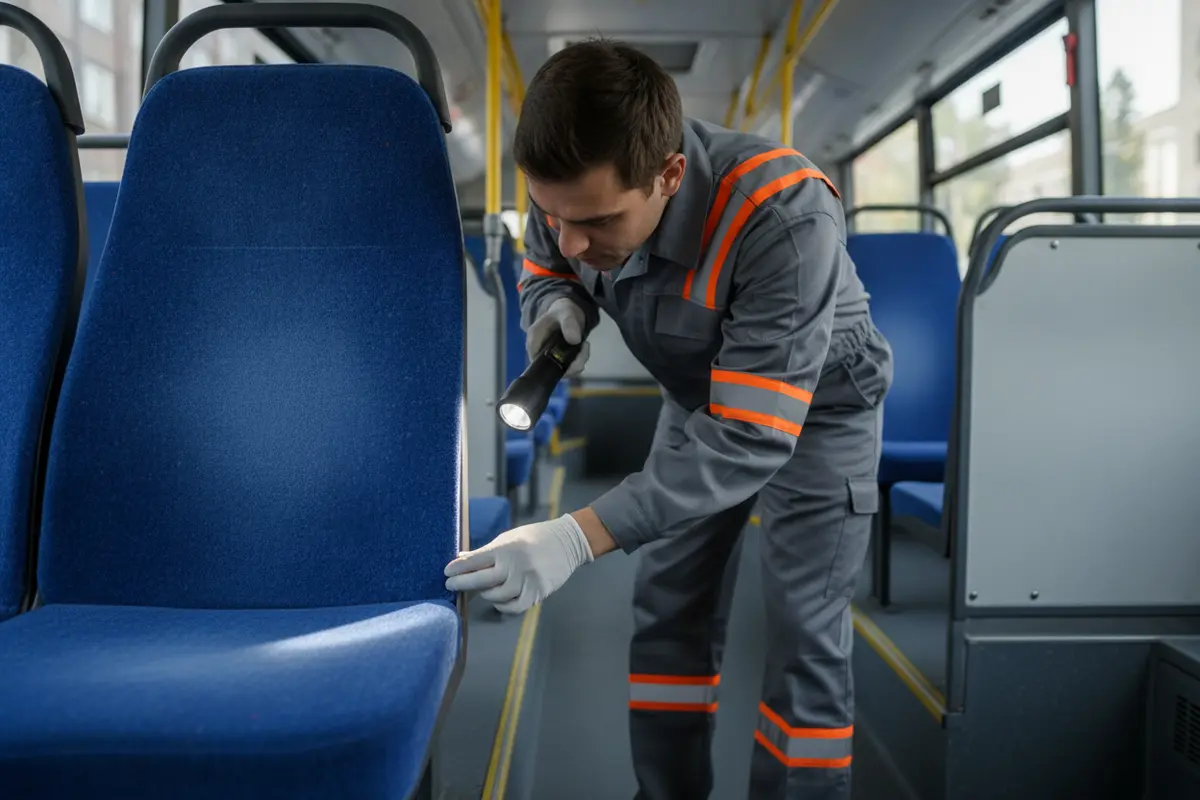
Use a flashlight and a deliberate visual check. Look for live insects, shed skins, eggs, or dark spotting that may be consistent with activity. Record exactly what was found and where, including negative findings in the inspected area. Do not dismantle vehicle components unless authorized and properly equipped. Keep the initial inspection bounded to the reported location and adjacent hiding places; expand only if findings or a qualified inspector support doing so.
Vehicle interiors differ. A fabric seat, a vinyl bench, a luggage shelf, and a driver compartment do not present identical inspection access. Staff should not pry open panels, reach into electrical housings, or use tools in a way that could damage equipment or create a safety hazard. If a suspected insect is in an inaccessible space, note that fact and refer it for an authorized inspection rather than attempting an improvised search.
Keep inspection notes specific. “No evidence found in the seam and underside of seat 12” is more useful than “vehicle clear,” because the latter can imply that every possible hiding place was examined. A bounded finding helps the next decision-maker understand what has and has not been checked.
The U.S. Federal Transit Administration’s transit safety and crime prevention initiative discusses using safety and security data to support agency measurement and benchmarking. It is not a bed bug protocol, but it supports the general practice of recording incidents consistently rather than relying on informal recollections.
How should an operator manage the vehicle while it is assessed?
There is no single response for every report. An unverified report without a specimen calls for a different response than a confirmed insect or several signs in a protected location. Consider the evidence, where it was found, whether other signs are present, and whether a replacement vehicle is available. Follow the agency’s safety, maintenance, and pest-management procedures.
| Situation | Practical response | What to avoid |
|---|---|---|
| Unverified report, no specimen or clear image | Log the details and arrange a focused visual check of the reported area. | Declaring an infestation or treating the fleet based on a report alone. |
| Possible specimen, uncertain identity | Secure it safely if available; seek identification and inspect the immediate area. | Discarding evidence or using an unapproved pesticide. |
| Confirmed insect or multiple signs | Use agency procedure to manage the affected vehicle or area and contact a qualified pest professional. | Moving potentially affected materials into another vehicle or storage area without advice. |
| Repeat findings or broader evidence | Coordinate a documented assessment of related vehicles or locations based on evidence and professional advice. | Making broad claims to passengers before facts are established. |
Whether to take a vehicle temporarily out of service should be determined by the operator’s procedure and the actual findings. A precautionary pause may be reasonable during an active assessment, but a single report is not automatically proof of a wider problem. Consider what needs to be inspected, how the vehicle can be isolated safely, and who must authorize its return to service. Keep a written record of the decision and its basis.
Do not apply household sprays, foggers, or improvised heat to a vehicle. Such actions can create exposure or equipment hazards and may not reach concealed insects. Do not transfer seat covers, loose fabric, tools, or other items from a suspect location to another vehicle without a plan. If an item must be moved for inspection or cleaning, identify it, contain it as appropriate, and follow professional or agency instructions.
For service background, review professional bed bug removal options and the overview of bed bug inspection in NYC. These pages can help a transit team frame questions for a site-specific assessment.
How do response options compare?
A visual check, a professional inspection, treatment, and follow-up are different steps. A staff visual check helps locate visible evidence but cannot always rule out concealed insects. A qualified inspection helps interpret the evidence and plan the next action. Treatment should follow assessment, not substitute for it.
| Option | Useful when | Limitations and considerations |
|---|---|---|
| Staff visual check | Initial triage of a specific reported location. | May miss concealed insects; staff should avoid unsupported identification claims. |
| Qualified pest inspection | Evidence is uncertain, repeated, or confirmed and a site-specific plan is needed. | Requires coordination, access, and records that identify the reported location. |
| Targeted professional treatment | An inspection supports treatment and a qualified provider selects a suitable method. | Preparation, downtime, and follow-up depend on the site, materials, and method. |
| Monitoring and follow-up | After findings or treatment, to check the concern and document the result. | Needs an assigned owner and a schedule for subsequent checks. |
Before agreeing to work, ask the provider to explain what evidence supports the recommendation, which areas are included, what preparation is needed, how passenger and worker access will be managed, and what follow-up is planned. Ask whether vehicle materials, seams, and adjoining areas change the method or timing. A useful proposal distinguishes inspection findings from assumptions and gives the agency a clear point of contact for questions.
For general background on treatment approaches, see Aprehend treatment information and heat treatment considerations. Methods are not interchangeable, and a choice should not be made solely because it sounds faster or more comprehensive. A treatment intended for a home may not be suitable for a moving vehicle or its particular materials; the provider must assess the actual site and follow applicable product directions.
Useful questions include whether the suspected evidence will be identified, how the affected space will be prepared, which vehicle components require access, what areas are outside the work scope, and how success will be checked. Confirm who is responsible for communicating any temporary vehicle restriction and who will approve return to normal use. These details prevent gaps between the inspection, maintenance, and operations teams.
How can transit teams reduce disruption and communicate clearly?
Assign one operations lead to coordinate intake, inspection, maintenance, and any outside provider. Maintain a short incident record with the vehicle, location, dates, inspection results, decisions, and follow-up. If a vehicle is temporarily unavailable, use ordinary service-continuity procedures. Avoid sharing unverified details as fact.
- Tell staff what was reported, what has been confirmed, and what action is underway.
- Give affected passengers factual information when appropriate, without identifying the reporter or making unsupported claims about exposure.
- Keep cleaning and maintenance instructions aligned with the inspection or treatment plan.
- Track repeat reports by vehicle, location, and date so the team can evaluate whether evidence is isolated or recurring.
- After the response, review whether intake, inspection, escalation, and documentation worked as intended.
Plan messages before the next shift or service update. A concise notice can say that a concern was reported, that the agency is assessing the specified area, and that next steps will follow its procedures. It should not label an area infested before confirmation or imply that every passenger or item was exposed. Provide a contact route for questions, and use the agency’s normal accessibility and language practices.
Bed bugs can move with belongings, so prevention messages should avoid blaming passengers or suggesting that a person is responsible for a report. Staff can encourage people to keep personal items close and report a suspected insect promptly while explaining that identification requires evidence. Do not ask staff to inspect or handle passengers’ belongings without a clear policy and appropriate authorization.
Good documentation also supports continuity across shifts. The record should show when the report arrived, who inspected the location, what was observed, what remained uncertain, what restrictions were applied, and when the next review is due. Keep relevant photos or specimen information with the incident record under the agency’s retention and privacy rules. That makes it easier to distinguish a new report from a repeat of an already assessed concern.
Operators in different parts of the city can consult service-area information for the Bronx, Queens, Brooklyn, and Manhattan. For the broader territory, see the service areas and the New York bed bug removal guide.
How should transit teams plan a repeat-report review?
A single incident record supports the immediate response; a pattern review helps decide whether the operating procedure needs attention. Review reports at a regular, practical interval and group them by vehicle, location, and date. Do not treat every repeated mention as independent evidence: a passenger may report the same event through several channels, or staff may be forwarding an earlier report.
When reports appear to cluster, compare their details before expanding an inspection. Consider whether they concern the same seat or compartment, whether specimens or signs were confirmed, and whether the reports came from separate trips. Ask the inspector whether the evidence supports checking nearby vehicles or facilities. This keeps the scope proportional while making room for a broader assessment when facts justify it.
Review operational handoffs too. Did the first person receiving the report know what information to collect? Could maintenance locate the area from the record? Were any items moved, and were they tracked? Did the appropriate lead make the service decision? A short after-action review can identify a missing form field, an unclear escalation path, or a training need without assigning blame to an individual passenger or employee.
Keep the process useful rather than burdensome. A brief standard checklist, clear responsibility for follow-up, and a consistent place to store inspection notes are usually more actionable than a complicated form that staff cannot complete during service. Update the procedure if the agency learns that a location is hard to inspect or that a handoff repeatedly leaves unanswered questions.
Frequently Asked Questions
Can bed bugs live in buses or trains?
They can hide in protected crevices, including seams and gaps around seating or panels. A report does not establish an infestation; reliable identification and inspection are needed.
Should an operator close a route after one report?
Not automatically. Follow agency procedures and consider the report’s evidence, inspection findings, and operational needs. A confirmed finding may justify a vehicle-level response, but one unverified report is not proof of a wider problem.
Can staff spray a suspected seat?
Staff should not use household sprays, foggers, or unapproved products on transit equipment. Consult the agency’s pest-management procedure and a qualified professional before treatment.
What information should the incident record include?
Record the date and time, vehicle and location, description of the insect or signs, any photo or secured specimen, inspection results, actions taken, and follow-up. Keep personal details limited to what the response requires.
When should a transit agency contact a pest professional?
Seek advice when identification is uncertain but concern remains, when an insect is confirmed, when multiple signs are found, or when reports recur. A professional can assess the specific vehicle or location and explain appropriate options.
Discuss a transit vehicle inspection
Keep the response evidence-led
A measured response helps transit teams protect passengers and workers while avoiding unnecessary disruption. Document the concern, inspect the reported area, base restrictions or treatment on evidence, and follow up to confirm that agreed next steps are complete.