
If an employee reports bed bugs, an employer should respond promptly, privately, and based on evidence—not blame or assumptions. The practical answer to what can an employer do if an employee has bed bugs is to listen, limit unnecessary movement of belongings, assess the reported location, and seek qualified guidance before deciding on treatment. Bed bugs do not mean a workplace is unclean, and a report alone does not confirm an infestation.
Request an inspection or discuss next steps
What should an employer do first after a report?
Thank the employee for raising the concern. Speak privately and ask what they observed, where, and when. Avoid asking for unnecessary personal details or making the employee explain the issue in front of coworkers. A mark on skin, an insect seen briefly, or a secondhand report may not identify bed bugs. If possible, ask the employee to describe or photograph the insect or evidence without carrying potentially affected belongings around the workplace.
Do not accuse the employee of bringing bed bugs in or assume that the employee’s home is the source. Bed bugs can travel with belongings and may be encountered in many settings. A responsible response focuses on evidence and the work area, not on assigning fault. Use a designated manager or facilities contact to coordinate the response and keep communications limited to people who need to act.
- Record the report discreetly. Note the date, location, description, and any physical evidence observed. Keep the record factual and store it where access is limited.
- Ask the employee to avoid moving items between work areas. Do not instruct them to discard personal belongings or leave work as a default response.
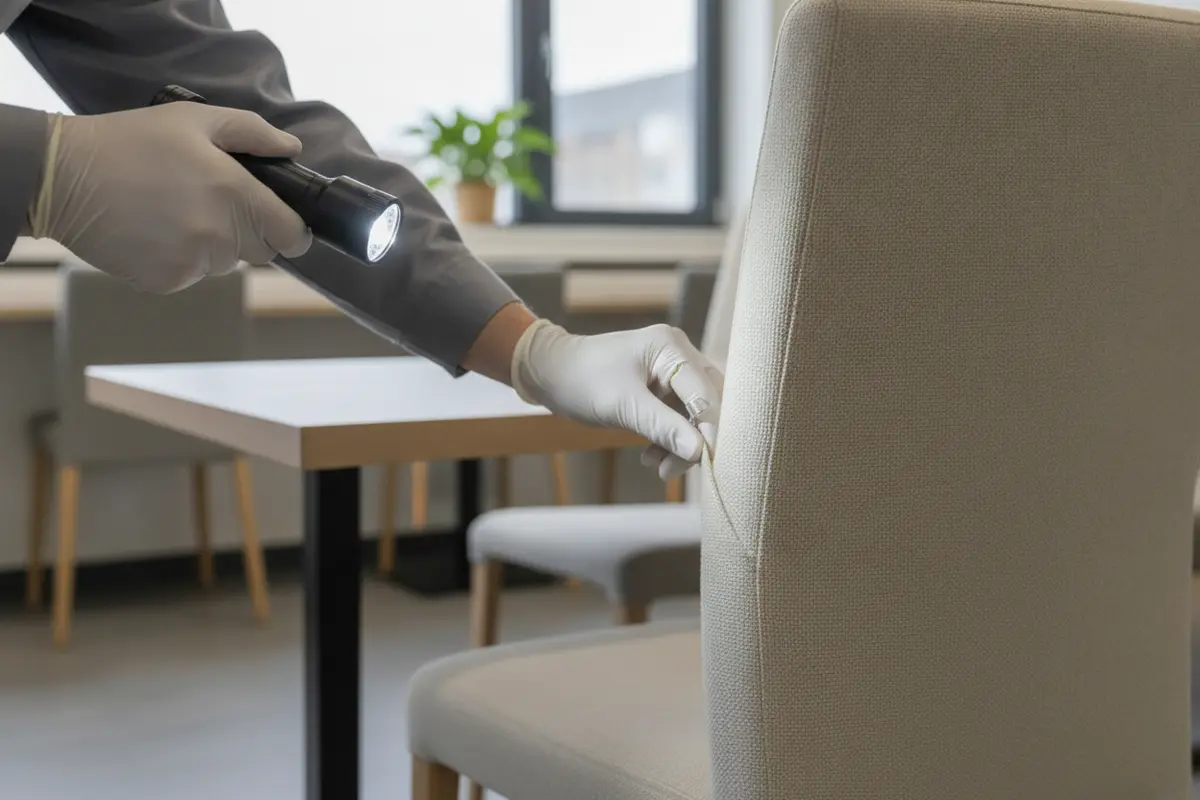
- Inspect the reported area carefully. Include nearby seating, seams, crevices, and places where bags are placed. Do not treat a room solely because someone reported a concern.
- Contact a qualified pest professional if evidence or uncertainty warrants assessment. Explain the setting, what was found, and whether the concern involves a shared or sensitive facility.
A useful first conversation is short and neutral. A manager might say: “Thank you for telling me. We will keep this private and check the location you identified. Please avoid moving the item or bag to another area while we arrange an assessment. I will update you when we know more.” This acknowledges the concern without diagnosing it or promising a particular treatment.
How can a business limit spread while it assesses the concern?
Use proportionate, temporary precautions. If a particular chair or small area is the focus, limit use of that item while it is assessed. Avoid moving it to another room, and do not carry potentially affected objects through the building. Keep the area orderly so an inspector can examine it. Do not seal an entire workplace or discard furniture on the basis of an unverified report.
Ask the employee to keep a bag or coat with them or place it in a designated, contained location if that is practical. Avoid creating a public “bed bug” station or marking an employee’s belongings. Explain the temporary steps neutrally: the organization is checking a reported pest concern and is taking reasonable steps to avoid moving items until the assessment is complete.
Think through how people use the space before setting restrictions. If the report concerns a chair at one desk, moving the employee’s entire team to another room may unnecessarily distribute belongings. If it concerns a shared coat area, a manager can temporarily direct staff to use another storage option while keeping bags from being carried through multiple departments. The goal is to reduce movement, not to create panic or impose broad restrictions without findings.
Workplaces vary. An office, hotel, clinic, shelter, school, and transit facility have different layouts and operational needs. For a school or other sensitive setting, any treatment decision should follow a case-specific assessment; there is no one-size-fits-all authorization. For other workplace settings, coordinate with the building owner or facilities manager where relevant, especially in shared or multi-tenant spaces.
What evidence should staff look for?
Bed bugs tend to hide in narrow, protected spaces near places where people rest or sit for extended periods. An inspection may include mattress or upholstery seams, chair frames, cracks, joints, and nearby stored items. Look for live insects and other signs, but do not treat every dark speck or skin mark as proof. When staff are not trained to identify pests, preserve a clear photograph or safely contain a specimen for professional identification rather than handling it extensively.
Keep the scope focused on the reported location and reasonable adjacent areas. A pest professional can advise whether the evidence supports expanding the inspection. If the report concerns sleeping quarters or guest accommodations, prioritize an assessment before assigning rooms or moving furnishings. For more background on signs and likely locations, see this guide to common bed bug hiding spots, the early signs checklist, and steps for checking carefully.
A simple evidence log can help: write down the precise item or room, when it was last used, what was seen, who observed it, and whether a photograph or specimen is available. Distinguish direct observations from interpretations. “Small insect found in chair seam at 10 a.m.; identification pending” is more useful than “employee brought bed bugs.” Avoid collecting extensive personal information that has no bearing on the worksite assessment.
How should an employer communicate with staff?
Share only confirmed, useful information. Tell affected staff what area is being assessed, what temporary precautions to follow, and when they can expect an update. Avoid naming the employee who made the report. Do not circulate unverified claims or identify someone as the source. If no evidence is found, explain that the assessment did not confirm bed bugs and state whether any follow-up is planned.
If evidence is confirmed, explain the next operational steps in plain terms. Treatment timing, room access, and preparation instructions depend on the inspection and chosen method. Provide instructions directly to people who need to prepare, and follow the professional’s written directions. Do not improvise pesticide use or ask untrained staff to apply a product. For general information on bed bug management and pesticide use, consult the U.S. Environmental Protection Agency.
Prepare a brief update that answers the questions staff are likely to have: which area is affected, whether access is temporarily limited, what employees should do with belongings, who is coordinating the assessment, and when the next update is expected. Avoid speculation about where the insect came from or whether a particular person brought it in. If the situation changes, issue a correction promptly instead of allowing rumors to fill the gap.
How do response options compare?
The right response depends on whether there is evidence, the type of space, and how widely the concern may extend. This comparison is a planning aid, not a substitute for an inspection.
| Situation | Reasonable next step | What to avoid |
|---|---|---|
| Unverified report, no insect or other evidence | Document details, inspect the reported area, and seek identification advice if needed. | Immediate building-wide treatment or public blame. |
| Possible evidence in one item or room | Limit use or movement of that item temporarily and arrange a focused assessment. | Moving furniture elsewhere or discarding it before guidance. |
| Confirmed evidence or multiple reports | Coordinate with facilities and a pest professional on inspection scope, communication, and a treatment plan. | DIY pesticide application or relying on one isolated treatment without follow-up guidance. |
| Shared building or sensitive facility | Coordinate the appropriate responsible parties and request a case-specific assessment. | Assuming one procedure fits every building or occupant. |
For example, one unconfirmed report about an office chair calls for a focused check, not automatic treatment of every floor. If an inspector then finds evidence in that chair and an adjacent storage area, the assessment can expand based on those findings. Conversely, if an insect is identified as something else and no other signs appear, the employer can document the result and return the location to normal use. The response should follow the evidence at each step.
How can an employer choose professional help?
Ask the provider to explain the inspection findings, the area included, what evidence supports the recommendation, and what preparation is needed. Understand who will perform the work, how occupants should handle belongings, and what follow-up or monitoring is recommended. Ask how the method will be selected for the particular site and what safety instructions apply. Do not rely on a promise of immediate, universal results; ask for a clear description of the plan and its limits.
A specialized provider may be useful when the concern is specifically bed bugs. Ace Bed Bug Exterminating describes a process involving inspection and assessment, treatment planning, and follow-up. Learn about its bed bug removal approach, review its bed bug inspection information, and read about the company and its specialized focus. Employers should confirm service availability for their location before arranging an appointment; the service area page provides geographic information.
When comparing providers, ask the same questions of each one so the recommendations are easier to evaluate. What locations will be inspected? What findings would change the scope? Who is responsible for communicating preparation steps? Is follow-up recommended, and what does it involve? How should a room or item be handled before and after work? A clear answer should connect the proposed action to site findings rather than rely on a generic promise.
For a Newark-area workplace, focus on provider qualifications, inspection scope, and local availability rather than assuming that a company serving New York City also serves every nearby community. Ask directly whether the property is within its service territory. The contact page offers a way to ask about a particular situation. A business should verify the location and operational details before scheduling so that the assessment can be planned appropriately.
What should the workplace prepare before an assessment?
Make the reported area accessible and identify a staff contact who can accompany the inspector. Provide a concise account of the report and show any photographs or safely contained specimen. Tell the provider about access limits, shared rooms, and relevant schedule constraints. Avoid extensive cleaning, moving furniture, or applying products immediately before the assessment, since those actions may interfere with an inspection or spread items.
Before work begins, ask for preparation instructions in writing. Confirm whether employees need to leave an area temporarily, how long access restrictions may last, and how the space will be cleared for use. The answer varies by method and site. For a multi-unit workplace or residential property, communicate with building management and coordinate access to adjacent spaces only as advised by the professional. Learn about Aprehend treatment and heat treatment as examples of approaches; these pages are informational, and the appropriate option depends on assessment.
A practical handoff checklist can prevent avoidable delays. Identify the exact location, arrange access, name one decision-maker, and gather observations and images. Tell the provider whether the room contains shared equipment, sensitive materials, or objects that cannot be moved. Ask staff not to vacuum, spray, dismantle furniture, or relocate items unless instructed. Once the inspection is complete, record the recommendation and the person responsible for each action.
How should the response differ by type of workplace?
In a small office, the concern may be limited to a single chair, coat area, or meeting room. Identify exactly where the employee observed the insect and whether others noticed similar signs. Do not close the full office unless the assessment supports doing so. If staff share desks or upholstered seating, tell the inspector how those spaces are used so the inspection can reflect actual contact patterns.
In a hotel, shelter, healthcare site, or other facility with frequent turnover, coordinate across operations and facilities teams. Keep a precise record of room or area identifiers, but do not post sensitive details publicly. The person responsible for the space should control access and ensure that an item is not moved into a clean area before it is assessed. Any decisions involving vulnerable occupants, patient care, or essential services require coordination with the facility’s established procedures.
For public transportation, the operator should identify the vehicle, seat or compartment, service period, and time of observation as accurately as possible. A vehicle may return to service on a tight schedule, so operations staff should coordinate access and inspection timing rather than moving a potentially affected seat or object into another vehicle. Do not speculate about a passenger or employee as the source. A professional can advise whether the inspection should include nearby seating, storage areas, or related vehicles based on actual findings and operational layout. Keep a record of any temporary restriction and the criteria used to return the vehicle or area to service.
In transit workplaces or vehicles, access and scheduling may be complex. Identify the vehicle, seat, time, and route or shift information that can help narrow the inspection, while avoiding unsupported claims about where the pest originated. The operational plan should keep potentially affected items from being shifted between vehicles or facilities without guidance. Communicate with dispatch, maintenance, and the facility contact so that everyone follows the same temporary plan.
For schools and other sensitive settings, decisions should be based on a case-specific consultation. The workplace should coordinate with the appropriate building decision-makers and follow its own health, safety, and operational protocols. Do not treat a report as automatic authorization for treatment, and do not assume that a response suitable for an office applies to a classroom, shelter, or care environment.
What common mistakes should employers avoid?
- Making a diagnosis from a bite. Skin reactions vary and cannot establish that bed bugs are present. Inspect the location and seek identification where appropriate.
- Blaming a worker or demanding personal details. The source may be unknown. Limit questions to information needed to assess the workplace concern.
- Moving items to another room. This can make an assessment harder and may spread the problem if bed bugs are present.
- Using foggers or unapproved products. Do not attempt a quick chemical fix without appropriate training and label-compliant direction.
- Making sweeping announcements. Communicate practical instructions to affected people while protecting the reporting employee’s privacy.
- Promising a specific outcome or timeline. Inspection findings and treatment requirements vary by site. Give staff updates when confirmed information is available.
Managers can prepare a short response checklist in advance: identify the designated contact, set a private reporting channel, define who can restrict access to an item, and decide how facilities staff will coordinate with a building owner. This is not a claim that every report requires professional treatment. It is a way to make a measured assessment easier when a concern is raised.
Another avoidable error is treating every location in a building as if it has the same risk. A report tied to one item is not evidence that unrelated rooms are affected. At the same time, an employer should not dismiss repeated reports merely because the first check did not confirm the issue. Track each report separately and let the pattern, inspection evidence, and professional advice guide any expanded response.
What should employers document afterward?
Keep a record of the initial report, inspection date, findings, decisions, communications, and any professional instructions. Record observed facts rather than conclusions about an employee or the source. Track follow-up checks and document when an area returns to normal use. If evidence is not confirmed, note that result as well. A clear record helps managers respond consistently if another report arises.
Review whether the response kept personal information private, prevented unnecessary movement of items, and gave staff clear instructions. If more than one location or report is involved, use the professional’s recommendations to determine the next steps rather than treating unrelated areas automatically. Employers should also consult their own workplace policies and appropriate advisers for employment or health questions; pest guidance is not a substitute for those decisions.
A short after-action review can identify practical improvements. Did the reporting employee have a clear person to contact? Could facilities staff restrict the item without causing unnecessary disruption? Were staff told what to do and when to expect an update? Were preparation directions understandable? Use the answers to refine the reporting channel and responsibilities, not to single out the person who raised the concern.
Contact Ace to discuss a workplace inspection
Frequently Asked Questions
Should an employer send an employee home after a bed bug report?
A report by itself does not establish that an employee has bed bugs or that they pose a workplace risk. Respond privately, assess the reported area, and follow workplace policies. Avoid singling someone out or making a decision based on an unverified assumption.
Should the employer throw away a chair or other furniture?
Not just because someone reported a possible bed bug. Keep the item in place if practical, limit its use temporarily, and arrange an assessment. Discarding or moving furniture can be costly and may carry pests to another area if bed bugs are present.
Can staff apply a store-bought pesticide?
Staff should not improvise pesticide applications. Follow product labels and workplace procedures, and use a qualified professional to assess the site and recommend an appropriate plan. Uncoordinated treatment can create exposure concerns and may fail to address the source.
Does one reported insect mean the whole workplace is infested?
No. The insect should be identified and the relevant location assessed. The scope of any further inspection depends on the findings, building layout, and professional advice.
What if a report involves a school or a shared facility?
Arrange a case-specific assessment and coordinate with the appropriate building or facility decision-makers. Treatment and access decisions should reflect the actual setting and findings, rather than assuming a universal procedure.
Keep the response evidence-led
A calm, evidence-led response protects privacy and helps an employer decide what to do next without rushing to blame, move belongings, or treat unconfirmed areas. Listen, document the facts, limit unnecessary movement, and use an appropriate assessment to decide what happens next.