
A bed bug hotel registry can help you find reports tied to lodging, but it is not a live inspection record or a guarantee that a room is clear. Treat a listing as one clue: check its details, ask the property specific questions, inspect your room calmly, and respond to evidence rather than a listing alone.
Request a free bed bug inspection
What a bed bug hotel registry actually is
A bed bug hotel registry is a website or database that gathers reports about suspected bed bug encounters at hotels and other lodging. Depending on how it is run, entries may come from travelers, businesses, inspectors, or other submitters. The word “registry” can sound official, but a public listing does not automatically mean a government agency inspected or confirmed the room.
Registries can differ in what they collect and how they handle submissions. One may display a date, property location, room details, and follow-up. Another may show only a name and an allegation. Read the registry’s description of its reporting and verification process before relying on an entry. If the site does not explain how reports are checked, do not assume they are verified.
For general identification and response information, the U.S. Environmental Protection Agency maintains its official website. Use authoritative general guidance to understand bed bugs; it cannot confirm a particular hotel report or the current condition of a room.
What can a listing and report confirm?
A listing can confirm what that registry records: perhaps that someone submitted a report about a named property on a certain date. Without independent verification and follow-up, it cannot establish whether bed bugs were identified, which room was involved, whether the property investigated, or whether any issue remains.
- It can raise a useful question. A recent, specific report may be a reason to contact the property and ask what it investigated.
- It does not establish the condition of your room. A report concerning one room does not prove the condition of another room or the whole building.
- It may not record what happened afterward. Unless the entry includes documented updates, you may not know whether staff assessed or treated the room.
- No listing is not proof of no past issue. A registry may be incomplete, limited to voluntary submissions, or out of date.
Keep a distinction between a report, a confirmed identification, and a current inspection. Those are not interchangeable. Even a detailed account may leave out important context, while an old entry may describe an issue that was addressed. Neither the age of a report nor its absence settles the question by itself.
How should you check a report before booking?
Use a consistent review rather than treating a registry as a scorecard. The purpose is to decide what to ask and what additional information would help—not to claim certainty from a single entry.
- Check the date. Note when the report was submitted and whether the registry shows a separate date for the alleged encounter. A report from years ago differs from a recent one, but age alone does not prove resolution.
- Verify the property identity. Compare the full name, street address, and city. Similar hotel names, different branches, and nearby properties can be confused.
- Read what the person actually describes. Does the report mention an insect, a room, and where it was seen, or only unexplained bites? Bites alone do not identify their cause.
- Look for verification and follow-up. Check whether the registry says who reviewed the claim, what evidence is required, and whether updates are recorded. If it does not say, treat the report as unverified.
- Compare the report with other available information. Look for clear, consistent details rather than repeating the same unsourced claim across sites. A repeated entry may simply copy one original submission.
- Contact the property with neutral questions. Ask whether it investigated the reported concern, when it did so, and whether the room you would occupy was assessed. A precise explanation is more useful than a broad reassurance.
- Decide in proportion to the evidence. Consider the report’s recency and detail, the property’s response, your travel needs, and your booking terms. A listing by itself need not dictate cancellation.
You can keep the conversation factual: “I saw a report dated [date] associated with this property. Can you tell me whether it was investigated and whether the room assigned to me has been checked?” This gives staff a clear question without presenting an unverified entry as established fact. Note the answer and the name or role of the person you spoke with, if available.
It can help to separate the review into three columns in your notes: what the registry says, what the property confirms, and what remains unknown. For example, an entry may name a hotel and a month but omit the room and evidence; management may say it reviewed the concern but not provide an inspection date. Writing those facts separately prevents a partial answer from turning into certainty in your mind.
When you compare two entries, check whether they refer to distinct visits or repeat the same account. Matching wording, dates, and details may indicate duplication rather than independent reports. Conversely, different dates and room details could represent separate reports, but still do not establish what is happening now. Focus on verifiable details and follow-up, not the raw number of search results.
How can you inspect a room without tearing it apart?
When you arrive, keep your luggage on a hard surface or on a luggage rack while you make a brief visual check. Use a phone flashlight if needed. You do not need to dismantle furniture or move heavy items. Focus on seams, folds, and accessible joints where signs may be visible.
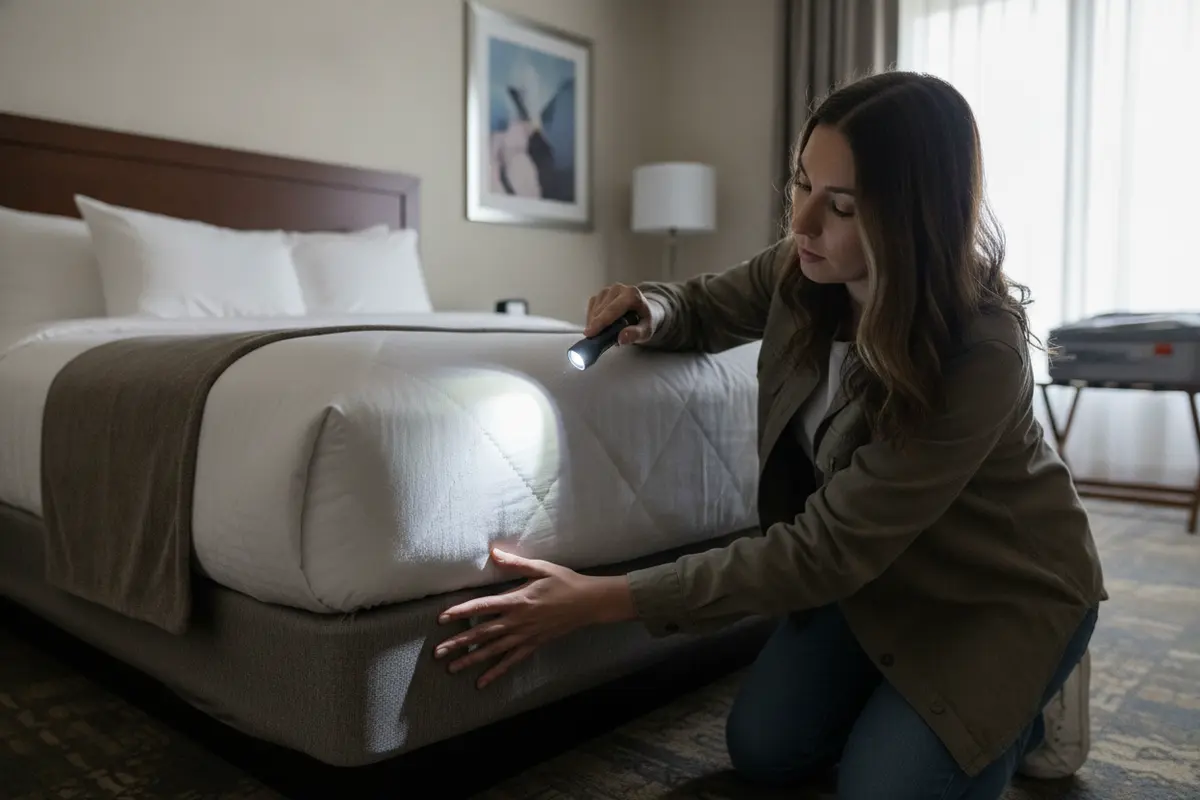
- Look along mattress seams, piping, corners, and visible tags.
- Check the accessible headboard area and bed-frame joints without forcing furniture away from walls.
- Scan nearby upholstered furniture and the luggage rack if you plan to use it.
- Notice possible live insects, shed skins, eggs, or dark spotting. A single mark may be ambiguous; do not identify a pest from a stain alone.
A visual check is limited to what you can see. It does not certify the room or building as clear. If you find something concerning, photograph it and contact the front desk or manager. Avoid handling a suspected insect with bare hands, applying household insecticides, or moving furniture. Ask staff to inspect and explain the available next steps. If a room change is offered, you can ask for a room that is not immediately adjacent to, above, or below the room of concern when feasible.
Make the check systematic and brief. Start at the bed rather than searching every corner of the room: inspect the mattress edges, then visible frame joints and the headboard area, and finally nearby upholstered seating or the rack. Keep the flashlight angled across a surface so raised debris or small objects are easier to notice. Do not pull apart a box spring, remove wall fixtures, or reach into electrical openings. If you cannot see an area safely, leave it for property staff or a qualified professional.
Do not rely on bites as a room test. Skin reactions vary, and a mark on the skin does not tell you which insect caused it or where exposure occurred. If you wake with irritation but find no physical evidence, report the concern to staff and ask for their inspection process instead of attempting to diagnose the source from appearance alone.
What should you document if the room concerns you?
Record facts, not conclusions. Note the property name, date, room number, and where you saw the possible sign. Take a close photo and a wider image showing where it was found. If you see an insect, avoid crushing or discarding it before asking staff how they want it handled; a clear photo can be useful for identification.
Write down whom you contacted, when you spoke, and what the property said it would do. Keep messages, booking details, and any information about an inspection or room change. If you later contact a health professional or pest management provider, a concise timeline can help you explain the concern. It does not replace professional identification.
For example, “dark mark on the mattress seam” is an observation. “Confirmed bed bugs” is a conclusion that needs reliable identification. Keeping those statements separate makes it easier for someone else to assess the evidence and helps prevent an uncertain sign from being repeated as a fact.
A useful record can be as simple as a dated note: “9:10 p.m.; room 412; small dark marks along the lower mattress seam; two photos taken; front desk notified at 9:18 p.m.; staff said a manager would come.” Add what happened next, including whether anyone inspected the room or offered another room. This sequence is clearer than a later summary that blends what you saw with what someone else told you.
When should a report change your travel plan?
Consider the whole picture. A recent, detailed report combined with an unclear property response may justify asking more questions or choosing another lodging option. An old or vague entry with no signs during your room check may call for ordinary precautions rather than an immediate cancellation. The right choice depends on your comfort, the information available, and the terms of your reservation.
If you see a possible insect or other concerning sign in your assigned room, stop unpacking and notify management. Ask what assessment or room-change options are available. If you are not comfortable with the response, you can decide whether to leave or seek different accommodation under your booking terms. A registry cannot make that choice for you, and a replacement room is not guaranteed to be free of bed bugs.
When a report is vague, ask for specifics rather than demanding a guarantee that no issue has ever occurred. When it is specific, ask what follow-up the property can describe. A calm, documented exchange gives you more actionable information than arguing about the registry’s label.
Think in terms of decision thresholds, not absolute proof. If you have only an undated post with no room or evidence, you may decide that asking the property is enough. If you have a recent account describing an insect in a named room and management cannot explain whether it investigated, you may prefer to pause unpacking and consider another option. Neither example dictates a single choice; your travel constraints, booking conditions, and comfort matter.
How do different information sources compare?
| Source | What it may tell you | What it cannot establish alone | Useful next step |
|---|---|---|---|
| Public registry entry | A report was submitted, sometimes with date and description | Whether it was verified or reflects current conditions | Check date, detail, property identity, and review process |
| Hotel management | What the property says it investigated or did | Independent confirmation if no supporting detail is provided | Ask specific, neutral questions and note the answer |
| Your visual room check | Whether you notice possible signs in accessible areas | That the entire room or building is clear | Document what you see and report it promptly |
| Qualified pest professional | An assessment of evidence or an inspection within its scope | Future conditions or areas not assessed | Follow the professional’s findings and instructions |
The table is a reminder that each source answers a different question. The registry helps you identify what someone reported; management can describe its response; your check can surface visible signs; and a professional can assess evidence within the scope of an inspection. Combining them thoughtfully is more useful than expecting any single source to answer every question.
How can you reduce the chance of carrying bed bugs home?
Practical handling habits can reduce unnecessary contact with furnishings while you assess a concern. Keep bags closed when not in use, and avoid putting clothing or luggage on beds or upholstered furniture until you have checked the room. These are precautions, not guarantees.
- Use a hard surface or a luggage rack after visually checking it.
- Keep worn clothes separate from clean items when practical.
- After travel, inspect luggage seams and pockets before storing bags near sleeping areas.
- If you have a specific concern, seek appropriate advice instead of applying pesticides to luggage or belongings.
Before checkout, check that personal items are packed rather than left on or around the bed. When you return home, unpack in a place where you can inspect your belongings, and keep travel bags away from sleeping areas until you have looked over seams, pockets, and folds. If an item appears concerning, avoid moving it through several rooms; contain it and seek reliable guidance on the next step.
If you notice a suspected bed bug after returning home, avoid carrying belongings from room to room. Photograph what you found, keep potentially affected items contained, and seek reliable identification. Ace provides practical information on how to check for bed bugs and early signs of bed bugs.
What should NYC residents do after finding signs at home?
A hotel registry concerns reports associated with lodging; it does not diagnose a home infestation. If you find possible signs at home, take photos and avoid moving potentially affected items through the building. A careful assessment can help determine whether evidence is consistent with bed bugs and where attention may be needed.
Learn about Ace’s bed bug removal services and bed bug inspection information. The company serves the five NYC boroughs and surrounding counties; its service area page provides coverage details. Find local information for Manhattan, Brooklyn, Queens, the Bronx, and Staten Island.
The New York bed bug removal guide offers additional general guidance. Keep the distinction clear: a travel report is a prompt to ask questions, not evidence that a particular NYC home or hotel room currently has bed bugs. If the evidence is uncertain, get it identified rather than relying on a registry entry or a bite pattern alone.
For more specific background, Ace also explains common bed bug hiding spots and bed bugs in clothing. These resources can help you take a measured next step without turning a travel report into a diagnosis.
For an NYC renter, it may also help to make a simple evidence folder before contacting a property manager or seeking an inspection: save the dated photos, note where the item was found, and list any actions already taken. Keep observations distinct from assumptions, especially if the original concern began with a lodging report. A professional can then focus on the home evidence rather than trying to infer a diagnosis from the registry entry alone.
Frequently asked questions
Is a bed bug hotel registry official?
Not necessarily. A registry may be a privately maintained collection of user reports. Check who operates it and how entries are reviewed before treating a listing as confirmed information.
Does a hotel registry report mean the hotel still has bed bugs?
No. A report may be old, unverified, or limited to one room. It does not establish current conditions, and no report does not prove a property has never had an issue.
Can I trust a hotel’s answer if I ask about a report?
Use the answer as one piece of information. Ask what was investigated, when it happened, and whether the room you will occupy was assessed. A specific explanation is more useful than a broad assurance, but it is not an independent inspection.
Should I cancel a booking after seeing a listing?
Not automatically. Consider the report’s date and detail, the property’s response, any signs you observe, and your booking terms. You can ask questions before deciding.
What should I do if I find a suspected bed bug in my room?
Avoid unnecessary handling and do not apply pesticide. Photograph the insect or sign, notify hotel management, and ask about assessment and practical options. If you remain concerned, decide whether to change accommodation.
Contact Ace about a bed bug concern
Keep the response evidence-led
A hotel registry can help you frame useful questions, but the report is only one part of the picture. Check its details, inspect accessible areas calmly, document what you actually see, and base your next step on evidence and the property’s response.