
A bed bug hotel registry is a public list of traveler-submitted reports, not a government inspection log and not proof that a room is clear today. The best-known example, The Bedbug Registry, says its reports are posted by users and have not been checked for accuracy. A listing can still help if you read the date, the address, and whether anyone disputed the note before you decide to book, ask for another room, or walk away.
Schedule a professional bed bug inspection.
What a Bed Bug Hotel Registry Actually Is
People search a bed bug hotel registry because they want a yes-or-no answer before a trip. The sites that rank for that phrase do not work that way. The Bedbug Registry, run since 2006, lets guests post what they saw at a hotel, motel, or other lodging. Its own FAQ says the site cannot be sure the reports are true. It also says some posts come from angry tenants, competitors, or people who are simply mistaken.
That is the whole product: a crowd-sourced notebook, not the New York City housing bedbug notice that apartment owners must give tenants, and not a health-department score. A blank page does not mean the property was inspected and cleared. A pin on a map does not mean an inspector confirmed live insects in that room this week.
Older travel write-ups repeat a figure from the registry itself: about 20,000 reports covering about 12,000 locations, counted in the summer of 2010. That number is a snapshot of how the site described itself more than fifteen years ago. It is not a current count of infested hotels, and it should not be quoted as one. Treat any total you see on a third-party blog as dated unless the registry page shows a fresh date next to it.
The same FAQ says posts can be anonymous if they follow the site’s rules. A false report is not simply deleted, because the site says it will not remove a report without the author’s consent, though it can mark a post as disputed. Posts older than two years may come down when that property has had no later report. A resolved problem can also be removed after the site contacts the original poster. Those rules matter when you judge a listing, because a missing old report is not the same thing as a clean bill of health.
What a Listing Can and Cannot Confirm
Read a report as a lead, the way you would read one guest review. It can tell you that someone claimed a problem at a named place on a stated date. It cannot tell you the insects were identified, that the room still has them, or that management fixed the issue. The registry says this outright: take reports with a grain of salt.
Use the table below before you treat any single entry as a verdict. If a field is missing, lower your confidence instead of filling the gap with a guess.
| What you can see | What it can support | What it cannot prove |
|---|---|---|
| Property name and street address. | You are looking at the right building, not a same-name hotel in another city. | It does not show that every room, or your assigned room, was affected. |
| Report date. | You can judge how fresh the claim is compared with your travel dates. | It does not show that the problem is still active, or that it was resolved. |
| Room number or floor, if given. | You get a narrower place to ask the hotel about. | It does not show that nearby rooms are clear, or that this room number still exists. |
| What the guest says they saw. | You get a starting point for your own look, such as spots, skins, or a live insect. | It is not a correct identification. Many small insects are not bed bugs. |
| A dispute note or manager reply, if the page shows one. | Someone challenged the report, so you should read both sides. | It does not show that the challenge is true, or that the original report is false. |
| No listing at all. | This supports nothing. The property may be missing from the database. | It does not show that the hotel is free of bed bugs. |
Match the address yourself, because hotel brands reuse names across a city and a renovated property may sit at a new street number. If you cannot find the hotel, the registry tells readers to email the name and address rather than assume the property is unlisted because it is clean. A search for “bed bug hotel registry near me” has the same limit. Near me only helps after you confirm the street address.
Several separate reports, close together in time, at the same address, are a stronger warning than one undated note. They are still not an inspection, and a database cannot look at the room for you. The EPA’s travel page tells guests to check the room they will actually sleep in. That page was current when checked in October 2026, so re-read it if the advice on luggage or room checks has been updated.
How to Check a Report Before You Book
Do this while you still have a free cancellation window. Write down the property name, street address, and the dates you would stay. Then open the registry and search that address, not only the brand name.
- Confirm the street address matches the booking, including the city and ZIP code.
- Read the newest report first, and note the date, the room or floor if given, and what the person says they found.
- Look for a dispute mark or a later note that the issue was fixed, and read it as a claim rather than proof.
- Search the hotel name plus “bed bugs” on recent guest reviews. One old complaint weighs less than a cluster from the last few months.
- Ask the hotel a direct question: when was the last time this room, or this floor, was checked for bed bugs, and what was the result?
- Keep your decision in writing by saving the booking screen, the report date, and any reply from the hotel.
A careful reading still leaves a choice, not a lab result. You can keep the booking and inspect on arrival, ask for a different floor before you arrive, or cancel if the pattern of recent reports bothers you and the rate rules allow it. None of those choices requires you to announce that the hotel “has bed bugs.” You only know that unverified reports exist.
New York travelers sometimes mix this search up with city housing rules. NYC Administrative Code section 27-2018.1 requires many residential building owners to tell tenants about bedbug history in the building. That notice is for housing, not a public hotel scorecard. If you need the stay-by-stay routine after you book, use the guide on what to do if you find bed bugs in a hotel room. This page stays on how to read the report itself.
If you live in the city and want a room at home checked after a trip, Ace Bedbug Exterminating inspects and treats bed bugs across New York City. A travel report is not a substitute for that visit. The New York bed bug removal guide explains how a local job is scoped once someone is back home.
How to Inspect the Room Without Tearing It Apart
The U.S. Environmental Protection Agency says you can usually inspect a room without special tools, though a flashlight helps. Check the mattress and headboard before you sleep, and check the luggage rack too. Keep the suitcase on that rack, off the bed and off the floor, while you pack or unpack.
Look, and do not dismantle the room, because you are a guest rather than a technician. Pulling off the headboard, moving outlet covers, or spraying a store product can damage the room and still miss the insects. Bed bugs hide in tight gaps, so a two-minute look at the places below is only a screen, not a clearance.
- Check mattress seams, piping, and the tag area, on both sides if you can lift the corner safely.
- Look at the gap where the headboard meets the wall, and any screw or fabric fold you can see without tools.
- Scan box spring edges and the dust cover if it is loose, without cutting the fabric.
- Check the luggage rack and the frame of a nearby nightstand before you set a bag down.
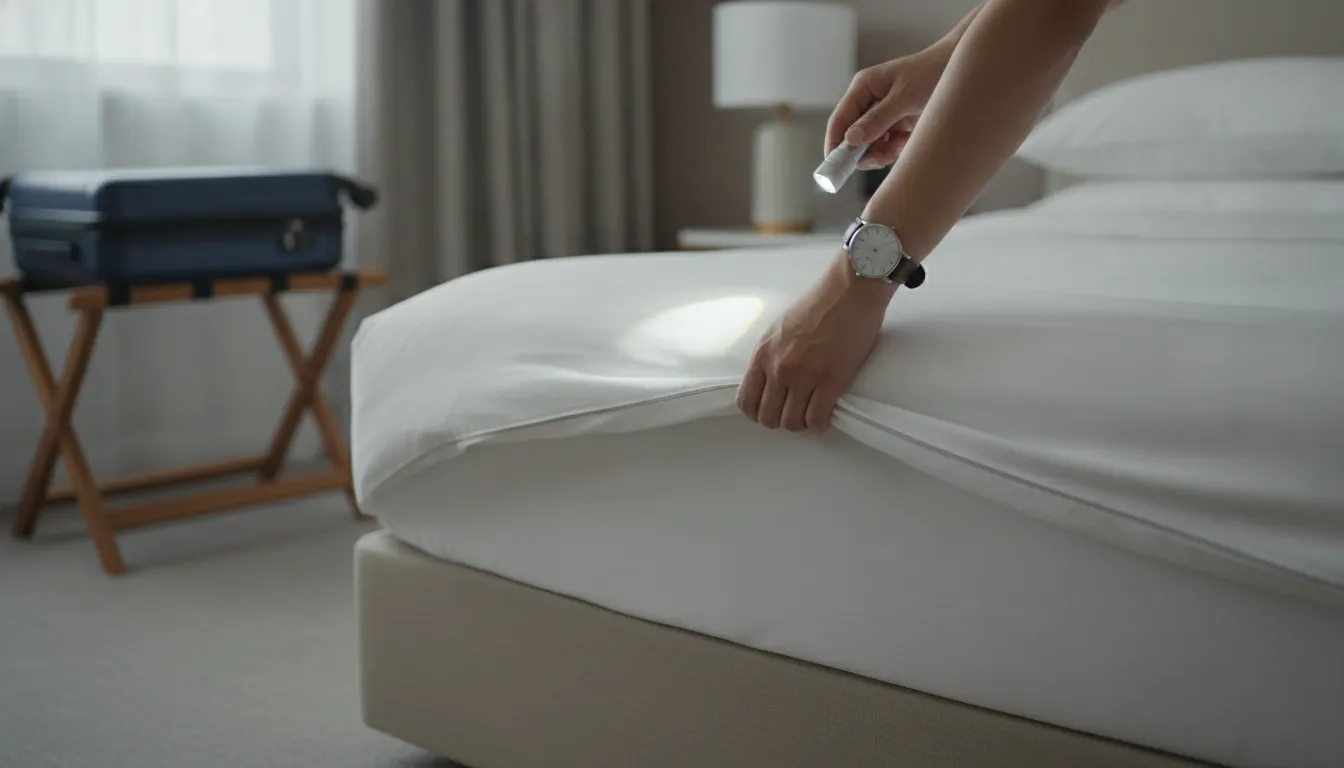
What counts as a sign is physical, not a feeling. Dark specks that smear, pale shed skins, and eggs stuck in a seam are the clues a later inspection would also note. A single speck of dirt is not enough to call it bed bugs. Our page on what mattress spots can mean separates stains from the marks that deserve a closer look. If you want the short list of gaps a technician opens first, see where bed bugs hide.
Night timing can fool you. Bed bugs are more active when a person is still, which is why a room can look empty at check-in and not at 3 a.m. That pattern is covered in when bed bugs come out. Do not stay up hoping to catch them. If the room already worries you, ask for another one before you unpack.
Bite-like marks are a weak clue by themselves, since many skin reactions look the same and some people do not react at all. For habits that lower the chance of bites on the road and at home, read how to prevent bed bug bites while traveling. Prevention steps do not confirm or clear a registry listing.
What to Document if the Room Concerns You
If you see something you cannot explain, stop unpacking. Leave the suitcase closed on the rack, tell the front desk in person, and then follow up in the hotel’s app or email so there is a time stamp. Ask for a room on a different floor, not the room next door. You do not need to accuse the staff of hiding a known problem. Describe what you saw and where you saw it.
Good notes are short and specific. Write the date and time, the hotel name, the street address, and the room number. Photograph the mattress seam, headboard gap, or insect next to something that shows scale, such as a coin you place beside it. Do not stage a scene, and do not post the photos as proof that the whole hotel is infested. Photos show what was in the frame at that minute.
Save three items before you leave the property. Keep the reservation confirmation, a screenshot of the registry report with its date, and the hotel’s written reply, even if a manager only says they will call. If you later ask a booking site for help, those three files are what a reviewer can actually check. This is record-keeping, not a guide to lawsuits or refunds. Those outcomes depend on the rate rules, the platform, and local law, and they are outside this article.
When you get home, the EPA’s advice is practical. Unpack into the washing machine if the clothes can be washed, and use a hot dryer. Washing alone is not what kills bed bugs, because the heat in the dryer is the step that does. Store the empty suitcase outside the bedroom, not under the bed. If you drove, the car is a separate question. Whether bed bugs can persist in a car is worth a look before you put the bag in a bedroom closet.
A home inspection is the right next step when you find a live insect, shed skins, or a cluster of spots you cannot explain, or when bites continue after the trip. Ace can inspect a New York City home and explain what was found. Start with a bed bug inspection in NYC if you want to know what the visit covers. If you only want monitoring after a scare, read how bed bug monitoring works. Monitoring does not clear a hotel, and it does not replace treatment if insects are already in the home.
When a Report Should Change Your Plan
Use the report to change a decision you still control. If the newest notes are recent, name the same address, and describe insects or skins in sleeping areas, do not unpack in that room. Ask for a different floor or cancel if you can. If the only note is several years old, disputed, and followed by silence, a careful room check may be enough. If there is no listing, inspect anyway, because absence of a report is not a result.
Heat is one tool technicians use in buildings, not something a guest should attempt with a portable heater. If you want to understand that method before you hire anyone at home, read how professional bed bug heat treatment works. Cost questions belong on a different page. What bed bug removal can cost depends on the size of the home and how widespread the insects are. A hotel listing does not set that price.
Travelers who live nearby sometimes want a same-day look after they return. Same-day bed bug help in NYC is for the home you came back to, not for treating a guest room you do not own. If you are comparing what a thorough home visit includes, what a structured bed bug inspection includes is a useful contrast. A registry post has no mattress check, no written findings, and no follow-up, while a real inspection does. Ace’s bed bug inspection page describes that first home visit as a look at a space Ace can access. Read that page for the current terms before you book. It is not a lookup of someone else’s hotel review, and it does not score the hotel you just left.
Ready to schedule a professional bed bug inspection? Contact Ace Bed Bug Exterminating.
Frequently Asked Questions
What is a bed bug hotel registry?
It is a website where travelers post claims about bed bugs at lodging. The Bedbug Registry is the site most people mean, and it is user-submitted rather than a city or federal inspection record. A listing is not proof that insects are there today.
Are bed bug hotel registry reports confirmed?
No. The Bedbug Registry says its reports are not vetted for accuracy and should be read with a grain of salt. A dispute mark means someone challenged the note, but it does not tell you which side is right. Only a direct look at the room, or a qualified inspection of a space you control, can confirm insects.
Can I search a bed bug registry for NYC hotels?
Yes. You can open a New York City view on a registry and then match the street address to your booking. City housing rules that make landlords disclose bedbug history apply to many residences, not to a public hotel grade. No listing is not the same as a passed inspection.
What should I do if a hotel appears in a bed bug registry?
Read the dates and the address first. If recent reports match the property, ask the hotel what was checked, and consider another room or a cancellation you are still allowed to make. On arrival, look at the mattress, headboard, and luggage rack with a flashlight before you unpack. Save screenshots of the report and any reply from the desk.
How can I inspect a hotel room for bed bugs?
The EPA says a flashlight is enough for a basic look. Check mattress seams, the headboard gap, and the luggage rack. Keep your bag on the rack, not on the bed or floor. Do not take furniture apart. If you see insects, skins, or clustered dark spots, stop unpacking and ask for a different floor.
Does a clear registry search mean the hotel is safe?
No. The property may be missing from the database, or a problem may never have been posted, so inspect the room you are given anyway. If you later find signs at home, schedule an inspection of that home rather than treating a screenshot as a diagnosis.