
Yes, bed bugs can live in a box spring. Its seams, folds, corners, frame, and underside can give them narrow places to hide close to a sleeping area. If you are asking whether bed bugs can live in a box spring, the useful next step is a careful inspection—not assuming that every dark mark or speck proves an infestation. Here is how to check, what evidence matters, and what to do next.
Request help with a bed bug inspection
Why can bed bugs hide in a box spring?
Bed bugs are flat insects that can shelter in narrow cracks and protected spaces. A box spring has multiple places that may provide cover: fabric edges, stitched seams, folds, staples, joints in the frame, and the dust cover underneath. When a bed is used regularly, these sheltered areas can also be close to a person at rest.
A box spring is not the only possible hiding place. Bed bugs may also be found in mattress seams, bed-frame joints, a headboard, nearby furniture, or other crevices around a room. Looking at only the top of the mattress can miss evidence on the underside of the bed or along its structure. For a wider room-by-room overview, see our guide to common bed bug hiding spots.
Finding a bug or suspicious mark on a box spring does not tell you by itself how large an infestation is or where else insects may be. It does mean the area deserves a closer look. If you need a broader overview of treatment and prevention, start with our guide to bed bug removal in NYC.
Where should you look on a box spring?
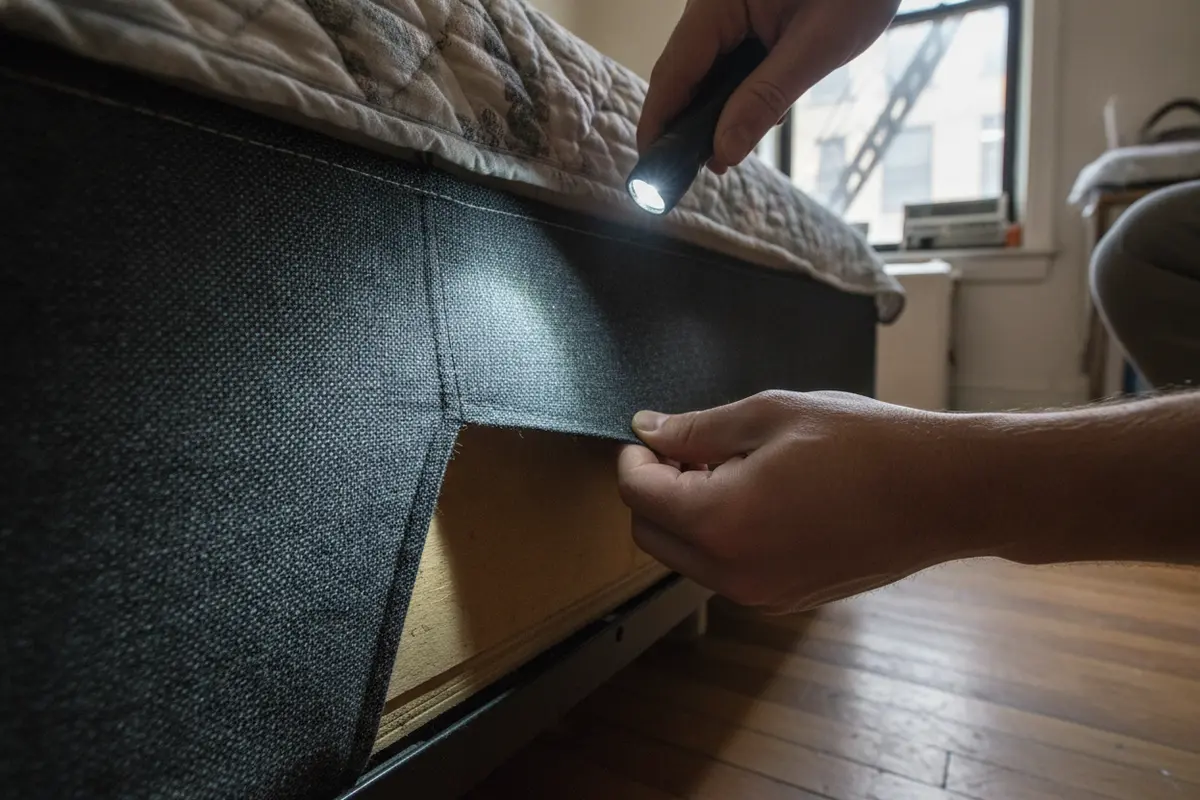
Inspect slowly and methodically. Begin with the places where fabric meets the frame, then check the underside and accessible structural joints. Use a flashlight, and avoid tearing material or reaching blindly into an opening. If the box spring is heavy or difficult to handle safely, do not force it; inspect the accessible edges and ask for help.
- Top and side seams: Follow the piping and stitched edges, including the corners where seams meet.
- Fabric folds and labels: Check folds, tags, and tucked fabric that create a narrow gap.
- Stapled edges: Look along the fabric attached to the frame, especially where it wraps around corners.
- Underside dust cover: Examine the thin fabric covering the bottom, including its edges, tears, and attachment points. Cornell Integrated Pest Management notes that inspection of a box spring or foundation is difficult because its internal structure and dust cover create many hiding places. Read Cornell’s box spring inspection guidance.
- Frame joints and corners: Check visible wooden or metal joints, screw openings, brackets, and places where parts meet.
- Contact points around the bed: Inspect accessible sections of the bed frame, headboard, and the floor or furniture close to the bed.
Move the bed only if it can be done without straining or scattering belongings. Do not drag the box spring through the home. A careful visual check is more useful than dismantling the bed and carrying parts into another room. If you want a structured process for checking more than the foundation, follow our step-by-step bed bug check.
What signs should you look for?
Look for insects as well as signs that may indicate their presence. Bed bugs and their immature stages are small, and visual identification can be difficult. Common clues to inspect for include live insects, shed skins, eggs, and dark spotting. Take a clear photo of anything suspicious before cleaning or moving it, and note the exact location.
- Live insects: A bed bug has a flattened oval body. Do not rely on color alone; lighting and the insect’s stage can affect how it looks.
- Shed skins: As bed bugs grow, they shed their outer skins. These may resemble a pale, empty insect shell. Compare a find with our guide to identifying bed bug shells.
- Eggs: Eggs are tiny and can be difficult to distinguish from other specks without close inspection. See what bed bug eggs look like for more context.
- Dark spots: Small dark marks may be evidence, but a mark alone is not a confirmed identification. Compare its location and appearance with other signs. Our guide to bed bug stains and marks explains why one stain should not be treated as a verdict.
Bites are not a reliable way to confirm that a box spring contains bed bugs. Skin reactions vary, and other causes can look similar. Instead of diagnosing an infestation from bites alone, look for physical evidence and consider a professional inspection if signs persist or you find a suspected insect. You can read more about early signs of bed bugs.
How can you inspect a box spring without spreading the problem?
A calm, contained inspection is better than a rushed teardown. The goal is to document what you see and avoid carrying possible insects to a different room. Use these steps in order:
- Prepare the area. Keep pets and children away while you inspect. Set a flashlight and a phone or camera within reach. Avoid placing clothing, bags, or bedding on another bed or upholstered chair.
- Check the bed in place. Start with the seams and edges you can see. Inspect each side, then look at accessible corners and the underside edge.
- Record evidence. Photograph a suspected insect or mark with its location noted. If you can safely collect an insect, place it in a sealed container for identification. Do not crush or smear it before taking a photo.
- Look at nearby bed parts. Examine the mattress seams, frame joints, and headboard without carrying them elsewhere. A finding on one part does not prove every other part is affected, but a connected inspection can help show whether the evidence is limited or broader.
- Keep items contained. Do not move loose bedding or stored items from the bedroom into another room uncovered. Avoid using a vacuum in a way that could release insects from the equipment; if vacuuming is part of a response, follow appropriate containment and disposal directions.
- Choose the next step from the evidence. If you find a suspected bed bug, repeated signs, or are unsure what you saw, arrange an inspection rather than applying an improvised treatment.
Do not cut open the dust cover just to see inside. The internal structure may be difficult to inspect, and tearing the fabric can make the box spring harder to evaluate. Do not spray household products into seams or openings. Misapplied products may create exposure risks, damage materials, or fail to reach hidden insects. If you have already used a product, keep its container and label available and tell the professional what was applied.
How is a box spring inspection different from checking a mattress?
The two parts of a bed need slightly different checks. A mattress has visible top and bottom surfaces, piping, labels, handles, and seams. A box spring or foundation often has fabric stretched across a frame, a dust cover underneath, and structural joints that may be partly concealed. Inspecting a mattress alone does not replace checking the foundation, and finding a sign on one component does not automatically prove the other is affected.
For the mattress, examine the seam where the top panel meets the sides, the corners, labels, handles, and any folds. For the box spring, pay closer attention to the fabric edges, underside, attachment points, and frame joints. If a bed has a separate headboard, inspect its accessible joints and the places where it meets the wall or frame. Keep your observations separate: write down which item had a sign and where, rather than describing the whole bed as infested based on an uncertain speck.
Do not stack the mattress and foundation on another bed or lean them against furniture while you inspect. If lifting one part is necessary, get help and keep it within the same room when practical. A box spring can be awkward and heavy; protecting your back and avoiding damage matters more than seeing every hidden surface immediately. If a safe view is not possible, mark the area for a professional to assess.
How should you document a suspicious find?
Good documentation can make a follow-up more useful, especially if you rent, manage a property, or need to coordinate an inspection. Record the date and time, room, exact item, and the precise location on that item. Take one wider photo that shows where the evidence was found and a close photo with enough light to show its shape. Include an object for scale only if you can do so without touching or disturbing the suspected evidence.
Keep your description neutral. For example: “small dark marks along the lower seam on the bedroom box spring; photo taken Tuesday” is more useful than a conclusion that the entire apartment has bed bugs. If you find an insect, do not rely on a blurry photo or a bite pattern to identify it. Save the image and, if safe, contain a specimen in a sealed container rather than carrying it loose. Note any product already applied and retain its label information.
Renters can share observations with the appropriate property contact and ask how access or inspection will be coordinated. Property managers can record the affected unit or room, the report date, and the steps taken to evaluate it, while limiting unnecessary handling of belongings. A concise factual record helps people respond to what is known without amplifying an unconfirmed report.
What should you avoid while you decide what to do?
It is understandable to want to act immediately, but several common reactions can make a bed bug concern harder to assess. Do not move the box spring, mattress, bedding, or bags into another room without a plan. Do not set suspect items in a hallway, laundry room, elevator, or curbside area where others may handle them. Keep the bedroom setup as stable as practical until you have documented the evidence and know what the next step will be.
Avoid relying on a single home remedy, strong scent, or surface treatment to settle the question. Such steps do not identify what caused a mark, and they may disturb evidence or leave insects concealed in areas that were not treated. Do not use a product in a way that conflicts with its label, and do not apply chemicals to bedding or a box spring unless the directions specifically permit that use. If treatment is being considered, tell the professional about any products already used so the assessment can account for them.
Keep sleeping and household items from being carried around uncovered. If you need to move laundry, place it in a closed bag and ask the appropriate professional or building contact what handling instructions apply. Do not discard belongings solely because they were near the bed. The right response depends on the item, the evidence, and any treatment plan; unnecessary disposal can add cost without resolving the source.
Finally, avoid making a diagnosis from bites or an online photo comparison alone. Take notes and images, and let the evidence guide whether a professional assessment is needed. A controlled, documented response helps you avoid unnecessary disruption while still taking a credible concern seriously.
Should you throw away a box spring?
Not automatically. Discarding a box spring without a plan can be costly and may make it harder to contain and manage the situation. Moving it through hallways or shared spaces can also risk spreading insects if it is infested. A suspicious mark or a single uncertain observation is not enough reason to carry the foundation out of the building.
First document the evidence and arrange an assessment when needed. If a professional determines that an item should be discarded, ask how to prepare and label it so another person does not take it and so it can be moved responsibly. Follow building procedures for large-item disposal. Do not leave a potentially infested foundation in a shared hallway or an area where neighbors may handle it.
Likewise, avoid buying a replacement before you understand the situation. A new box spring does not address insects that may be elsewhere in the bed area, and bringing in a replacement before the room is ready can complicate the response. A treatment plan should account for the room and the condition of its furnishings, not just one piece of furniture.
How do common box spring findings compare?
The table below can help you decide whether a finding calls for another look or a more direct response. It is a guide for organizing observations, not a substitute for identification.
| Finding | What it may mean | Practical next step |
|---|---|---|
| One unclear dark speck | It may have several explanations and does not confirm bed bugs on its own. | Photograph it in place and check nearby seams for additional signs. |
| Suspected live insect | It may be a bed bug or another small insect that needs identification. | Take a clear photo or contain it safely, then request an assessment. |
| Several shed skins or eggs in a seam | Multiple physical clues in a protected location merit closer evaluation. | Record the exact location and avoid disturbing or treating the area yourself. |
| Marks on bedding but no insect found | Marks alone cannot establish the source. | Inspect the foundation, mattress edges, frame, and nearby hiding places. |
| Signs at the foundation and other bed parts | Evidence may extend beyond one component. | Ask for a whole-room inspection and a plan suited to the findings. |
When should you arrange a professional inspection?
Consider a professional inspection if you see a suspected live bed bug, find repeated physical signs, or cannot confidently identify what you found. An inspection is also a sensible next step when signs appear in more than one part of the bed or when you live in a multi-unit building and need to coordinate a response. If you are in New York City, you can learn about the bed bug inspection process in NYC or review the details of our bed bug inspection service.
A professional can assess the item and surrounding area, distinguish likely evidence from lookalikes, and recommend next steps based on what is found. Treatment needs can vary by room and infestation conditions. Ace describes a service process that includes inspection and assessment, treatment planning, and follow-up. Learn more about Aprehend bed bug treatment or bed bug heat treatment as treatment approaches; the appropriate option depends on the assessment rather than a guess based on one furniture item.
Before the visit, make a short list of what you noticed and when. Point out the exact seam or underside area, show photos, and mention whether you saw an insect, shed skin, eggs, or only a mark. Share whether any item was moved or any product was applied. You do not need to pull apart furniture or prepare the room by throwing belongings away unless you receive specific instructions. Ask what areas will be inspected, whether access to the bed’s underside is needed, and what actions you should take after the assessment. Clear questions help you understand the findings and avoid guessing about treatment or disposal.
For a landlord, property manager, or business, keep the observation factual: date, room, exact location, photos, and steps already taken. Avoid stating that a building or neighboring unit is infested before it has been assessed. Coordinate access and any next steps through the appropriate building contact. Our overview of Ace service areas provides information about coverage.
Contact Ace to discuss an inspection
Frequently asked questions
Can bed bugs live inside the box spring, not just on its surface?
They can hide in protected seams, folds, frame joints, and accessible openings around a box spring. The fabric dust cover and internal structure can make a thorough inspection challenging. Do not cut into the foundation; have a professional assess suspected evidence if the inside cannot be checked safely.
Does finding one bed bug mean the box spring is infested?
A confirmed bed bug is important evidence, but one finding does not by itself show the full extent or prove which furniture pieces are affected. Record where it was found and inspect the connected bed area. A professional can help assess the scope.
Can I treat a box spring with a store-bought spray?
A spray may not reach insects hidden in seams or the internal structure, and using products contrary to their labels can create risks. Avoid applying a product into openings or onto sleeping surfaces unless its label specifically permits that use. A treatment decision should follow an inspection and product directions.
Should I remove the dust cover to inspect underneath?
Do not tear or cut the dust cover as a first step. The bottom fabric and its attachment points can be inspected visually where accessible, but opening it may disturb the structure and will not necessarily reveal every hiding place. Ask a qualified professional if the area remains uncertain.
Can a bed bug inspection confirm whether the box spring is clear?
An inspection can evaluate visible evidence and accessible areas, but no brief visual check should be described as a guarantee that every concealed insect has been found. Share what you observed and ask what the inspection covers and what follow-up is appropriate.
Use evidence to choose the next step
Bed bugs can hide in a box spring, particularly around seams, folds, the underside cover, and frame connections. Check carefully without dismantling or moving the item through the home, document any suspected signs, and arrange a professional assessment when evidence is uncertain or repeated. A measured inspection is a safer starting point than discarding furniture or applying an improvised treatment.