
If you are asking about bed bugs in a recliner and what to check, start with the seams, folds, joints, and accessible underside—not just the seat. Upholstered furniture can have protected crevices where an insect may shelter, especially near places where people rest. A calm visual check can help you decide what to do next, but one mark alone cannot confirm an infestation.
Contact Ace about an inspection
Why can a recliner provide hiding places?
A recliner combines upholstery, seams, a frame, and moving parts. Depending on its design, narrow spaces can occur around the seat, back, arms, footrest, and reclining mechanism. Bed bugs can shelter in tight spaces; they are not limited to beds. A chair used often may also be close to someone for long periods, so it is sensible to include it in a room check when other signs raise concern.
That does not mean every recliner with a dark speck has bed bugs. Dust, lint, food crumbs, ink, and ordinary wear can look suspicious at first glance. Look for a pattern of clues and consider the setting. Recent skin marks or a confirmed concern elsewhere may justify checking carefully, but skin reactions alone do not identify bed bugs. Ace’s bed bug removal guide explains why an assessment should guide the next step.
Think of the chair as one part of the room, not as a stand-alone test. A finding on a seam matters more when it appears alongside other physical clues or similar evidence nearby. Conversely, a single crumb or stain with no other signs is a reason to look more carefully, not a reason to assume the worst. This distinction helps you stay observant without turning an uncertain mark into a diagnosis.
Where should you look on a recliner?
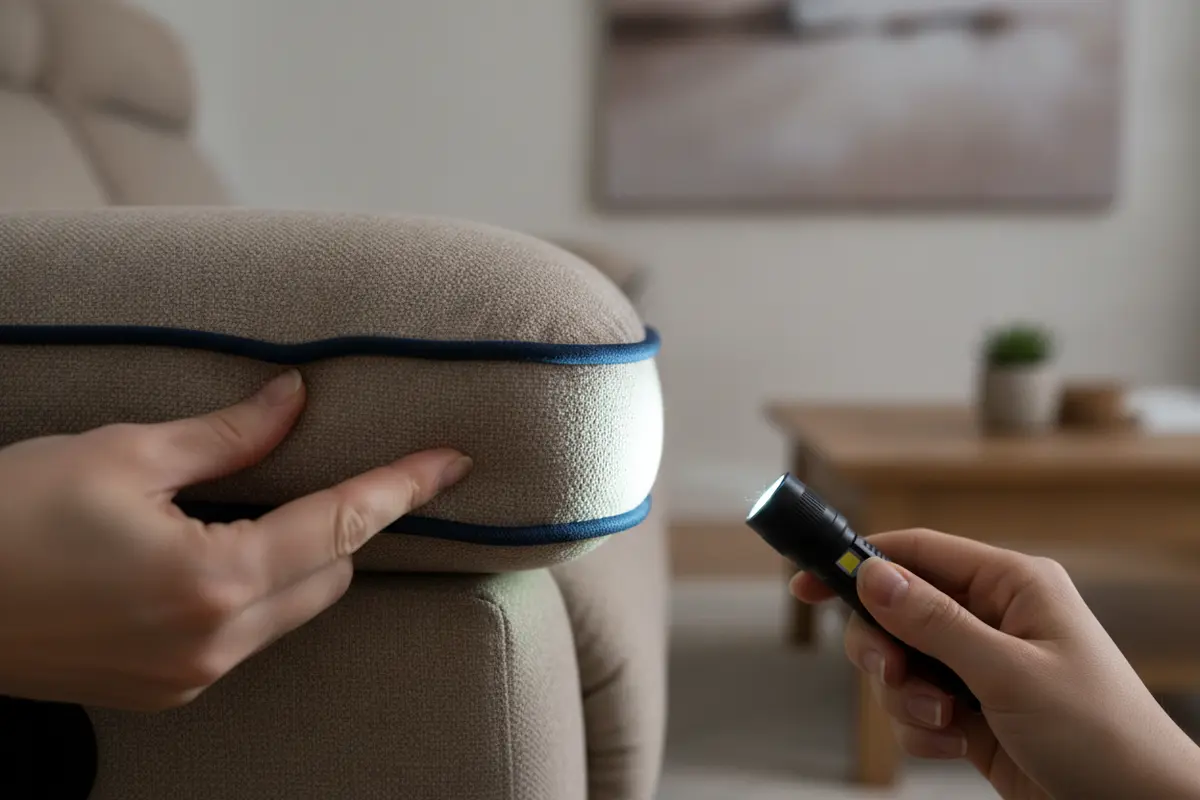
Use a bright flashlight and examine one area at a time. Begin where fabric meets fabric or fabric meets the frame. You do not need to dismantle the chair or force upholstery open. Move a cushion only if it is designed to come off easily, and keep your hands away from the mechanism. A slow, repeatable route is more useful than flipping the chair around or searching randomly.
- Seat cushion: Check piping, seams, buttons, tufting, zipper edges, and the gap between a removable cushion and the chair body. Look along both sides of the seam, where fabric can fold over.
- Back cushion: Inspect seams, folds, zipper edges, and the junction between the back and seat. If the chair reclines, check the back in its normal position and again when adjusted safely.
- Armrests: Look along the underside and where each arm joins the seat. Decorative trim, welting, and folds can create sheltered edges that are easy to overlook.
- Footrest: Examine fabric edges and folds with the footrest closed and extended, only if you can move it safely. Check the area where the footrest meets the seat without reaching into the hinge.
- Rear and underside: Look at the fabric dust cover, seams, staples, and accessible frame edges. Do not remove a cover if doing so could damage the chair or expose hardware.
- Visible joints: Check accessible gaps around the reclining structure without touching springs, wiring, motors, or pinch points.
Use the same systematic approach as this guide to common bed bug hiding spots. For a room-by-room routine, see how to check for bed bugs and the New York bed bug removal guide.
What signs should you look for?
Look for evidence attached to or clustered around protected areas rather than relying on one isolated mark. Possible clues include live insects, pale shed skins, tiny whitish eggs or eggshells, and small dark fecal spots. Rust-colored smears can occur if a bug is crushed, but stains have many other causes. The location and combination of clues matter, but visual clues may still need identification.
A useful check is to note whether a mark is on a seam, tucked into a fold, or on an exposed surface that collects everyday dirt. Also consider whether there is more than one type of clue in the same area. Several different signs close together deserve closer attention than a lone speck, but appearance alone can still be misleading. If you cannot tell whether an object is an insect, a skin, or ordinary debris, preserve the location and ask for help identifying it.
If something looks suspicious, do not squash it or brush it away. Take a clear photograph with a size reference nearby, if possible, and note the exact location. If you can safely collect a specimen, place it in a sealed container or bag; avoid handling it directly. Comparing a photo with what bed bugs can look like can help you describe what you saw, but a photo may not be enough for identification.
How can you inspect without spreading the problem?
Before you begin, decide where you will put the flashlight and phone, and keep bags, clothing, and loose items away from the chair. Avoid carrying cushions into another room. Keep children and pets clear of the work area while you look, especially if the chair has moving parts. The aim is a visual inspection, not an attempt to treat or dismantle the furniture.
- Prepare the area. Set a flashlight and phone within reach. Clear a small working space around the recliner, but do not move other furniture or personal belongings through the home just to make room.
- Inspect one section at a time. Start with accessible seams and edges, then check the underside and visible frame. Use gentle movements and avoid reaching into hardware. If the chair is powered, leave cables and electrical parts alone.
- Keep loose items contained. If a removable cushion cover or nearby textile must be moved, place it directly into a sealed bag instead of carrying it uncovered through the home. Do not remove a cover unless it is intended to be removable.
- Record observations. Photograph marks and note the location, date, and whether you saw an insect, skin, or stain. Describe what you observed rather than concluding what caused it.
- Stop when access is unsafe or difficult. Do not dismantle the chair or put your hands into springs or motorized parts. Leave inaccessible areas for a trained professional.
The U.S. Environmental Protection Agency offers general pest-management and pesticide information at its official website. For possible bed bug concerns, an inspection and a decision based on findings are preferable to applying a product by guesswork. Read the label on any pesticide you use and never apply a product to furniture unless the label allows that use. You can also review Ace’s information about bed bug inspections in NYC. If other upholstered pieces are involved, compare with the guide to bed bugs in a couch.
How do common recliner findings compare?
A quick comparison can keep one ambiguous mark from driving an unnecessary decision. Use this table to choose what to document and what to check next, not as a substitute for identifying an insect or arranging an assessment when needed.
| Finding | What it may indicate | Practical next step |
|---|---|---|
| Live, identifiable insect | A strong reason to seek identification and assess nearby areas | Photograph or safely contain it; avoid moving the chair |
| Several dark spots in a seam | Possible fecal spotting, though dirt and stains can look similar | Document the cluster and ask for an assessment if uncertain |
| Pale cast skins or tiny eggs | May be associated with bed bugs; visual confirmation matters | Take close photos and preserve the location |
| One isolated stain or crumb | Insufficient by itself to establish bed bugs | Check nearby seams and look for corroborating evidence |
| Skin marks without furniture evidence | Skin marks alone cannot establish the cause | Inspect the sleeping area and seek medical advice for health concerns |
For example, a single dark spot on an exposed armrest may be ink or dirt; photograph it, then inspect the adjacent seam for other signs. A small cluster tucked into a protected fold is a more specific reason to document the area and get the evidence identified. The distinction is not a guarantee either way. It is a practical way to decide whether the next step is simply continued observation or a closer professional look.
How should you check different recliner designs?
Not every chair offers the same access. A simple manual recliner may have a visible lever and accessible underside, while a powered model can have wiring or components that should not be disturbed. A chair with removable cushions may allow a closer look at cushion seams; a fixed cushion does not. Adjust the inspection to the chair rather than trying to make every model open the same way.
- Removable seat or back cushions: Lift them only as intended by the manufacturer. Look at both cushion edges and the surface beneath, then return each piece without dragging it across the floor.
- Fixed upholstery: Use a flashlight at seams and folds. Do not pull stitching, unzip covers that are not intended to be removed, or insert tools into gaps.
- Power recliner: Keep away from cables, electrical components, and moving parts. Do not unplug or tip a heavy chair unless the manufacturer’s instructions make the step safe.
- Chair with a dust cover: Inspect its visible perimeter. A stapled or tightly fitted cover is not an invitation to remove it during a basic check.
- Leather or vinyl chair: Check stitched seams, folds, and areas where upholstery meets the frame. A smooth surface may be easier to view, but seams and joins still deserve attention.
When a suspected clue sits behind a panel or deep inside a mechanism, note the location and stop. A limited inspection that avoids injury and damage is more useful than a forced examination that leaves the chair harder to assess. If you cannot tell whether a section is safely accessible, photograph the exterior seam and ask for advice rather than prying it open. For a wider look at household items that may need attention, see the guides to checking books and belongings and handling clothing safely.
What should you do after finding a suspicious mark?
Keep the finding and your response proportionate. First, photograph it in place, then take a closer image if your camera can focus. Include the surrounding seam in one picture and a detail in another. Write down whether the mark was on top of the cushion, underneath it, or on the frame. If the object is a specimen, store it securely and avoid carrying it loose.
Next, inspect nearby resting places and furniture without moving items between rooms. A recliner may be one clue in a broader picture, not the only place to assess. Check the bed area, nearby upholstered seating, and the floor edge around the chair with a flashlight. Ace’s early signs guide and its article on identifying shed skins can help you describe observations. If you see evidence in several places, list each location separately instead of assuming all marks have the same source.
Write down what you did during the check as well. For instance: “November 10, rear left seam, two dark marks, no insect seen; photographed.” This is more useful than a note that simply says “bed bugs,” because it preserves what is known and what remains uncertain. If another household member checks the room later, they can compare the same areas rather than repeating the inspection from memory.
What should you avoid doing?
- Do not drag the recliner outside or into another room. Moving furniture can spread pests if they are present and may complicate assessment.
- Do not spray household insecticide into the chair. Improvised application may be unsafe and may not reach hidden insects. Use products only as their labels direct.
- Do not apply alcohol, gasoline, or other flammable liquids. These create serious hazards and are not a reliable treatment.
- Do not discard the chair immediately. Removal may be unnecessary, and moving a suspected item through shared spaces can create problems. If removal is advised, ask how to contain and label it.
- Do not dismantle the reclining mechanism. Springs and moving components can injure you, and dismantling can make later assessment harder.
- Do not rely on one home remedy. A quick surface cleanup cannot establish that hidden areas are clear. Keep a record and choose next steps based on evidence.
- Do not donate or pass the chair to someone else while the concern is unresolved. If later removal is recommended, follow local disposal guidance and make sure the item is not presented as usable furniture.
Bed bug work may involve more than one item. A professional can assess surrounding areas and recommend an approach based on what is found. Learn more about bed bug removal and treatment options before deciding what kind of help to request.
When does a professional assessment make sense?
Consider arranging an assessment if you find a live insect or repeated clues, if nearby furniture or sleeping areas show possible signs, or if you cannot interpret what you found. It also makes sense when the only suspected evidence is in a part of the chair you cannot inspect safely. An inspection can help determine whether the concern appears limited to one piece of furniture or needs a wider look.
Before making contact, gather details that will make the conversation clearer: your neighborhood, when you first noticed the clue, the exact spot on the recliner, whether you have a photo or specimen, and whether there are observations elsewhere. If you rent, tell the property manager promptly and share factual notes rather than conclusions about the source. In a multi-unit building, coordination can help determine who should assess adjoining or shared areas.
A useful description can be brief: “I saw several dark marks along the underside seam of a recliner on Tuesday. I took two photos and have not moved the chair.” You do not need to diagnose the marks before asking for an inspection. If you manage a business or shared space, record which chair and room are involved, limit unnecessary handling, and follow your organization’s reporting process.
Ace Bed Bug Exterminating serves New York City and surrounding areas. Its process begins with inspection and assessment, followed by a treatment plan based on findings. See the service area page for coverage information, learn about Ace’s bed bug focus, or review the bed bug inspection service. For an overview of the broader process, visit the New York bed bug removal guide.
Ask Ace about your recliner concerns
Frequently asked questions
Can bed bugs live inside a recliner?
They may hide in seams, folds, joints, and gaps in upholstered furniture. Finding a recliner in a room does not prove they are there; look for identifiable evidence and consider the surrounding area.
Should I sit in the recliner while I investigate?
If you have found possible evidence, avoid unnecessary use until you have documented it and decided on next steps. Do not move the chair to another room. An inspector can advise whether it should be isolated or examined further.
Will vacuuming the recliner solve the problem?
Vacuuming may remove loose debris, but it cannot establish whether bed bugs are present or reliably address hidden insects and eggs throughout a chair. If you vacuum for cleanup, seal and dispose of the contents carefully, then continue with identification and assessment rather than assuming the concern is resolved.
Do bites prove that bed bugs are in my recliner?
No. Skin marks can have many causes, and people may react differently. Use physical evidence and a careful inspection, and consult a health professional about concerning symptoms.
Should I throw the recliner away if I find a suspicious mark?
Not based on one mark. Photograph it, check the surrounding seams, and seek identification if the evidence is unclear. If the chair is ultimately removed, contain it and follow local disposal guidance so it is not passed to someone else.
Use evidence to choose the next step
A methodical check of seams, cushions, the underside, and accessible joints can clarify whether a recliner has signs that merit attention. Document what you find, avoid risky sprays or unnecessary furniture movement, and arrange an assessment when evidence is repeated, uncertain, or difficult to reach safely.